Americans have long since taken to roasting themselves inside those ovens of artificial sunshine in attempt to, by any means necessary, bypass that middle-aged basement dwelling son of the energy world, solar power. That big ball of gas, situated at the center of our universe, was adequate for a time, but in the same way that the good people at Chia improved upon the previously perceived perfection of grass, so Edison was able to deposit dazzling cargoes of light into those places that had never before felt the torch-like touch of that luminous substance. And with this innovation, the darkness vanished, and was immediately replaced by its incandescent counterpart. However, from dark to light was only one of two directions that this newfound technology was capable of navigating. That is, thanks to the illuminating efforts of numerous brilliantly bronzed pioneers, seeking to cure a Hollywood diagnosed plague of paleness, a reversal was realized, and these bright bulbs were proven quite effective in darkening skin poor on pigment.
As time went on, science was successful in both the careful classification and subsequent manipulation of the properties that this new direction promised. For instance, when the inability of these fabricated rays to pierce a mere sticker was observed, researchers responded by harnessing this lack of penetration. Paper patches were cut into shapes tracing only the most tasteful assortment of nationally recognized symbols and then laid upon the bare skin of some brave, but peach participant. The radiant result was something similar to a sun stained silhouette, given shape by a two toned contrast on its fleshy canvas. My personal favorite design was the “Alfred Hitchcock”. Nothing ever seemed to compliment a golden brown tan like that pudgy profile.
Needless to say, as a plant basking in the nourishing rays that the sun generously, yet feebly offers, will bear much fruit, so have these labors bore a bountiful harvest, fueled by their own super-solar source and ripened by the darkening demand of the times. However, to some around the world, such progress is a puzzling thing. To them, jumping into the booth is, in effect, taking that TGIF inspired regression from the suave Stefan back to the awkward Urkel. Sure the latter cared more about Laura, but the former got to share the stage with New Edition.
(Note: In regards to the last reference, I do encourage anyone reading this to investigate the scientific merits of “cool juice” and/or “boss sauce”. I personally can’t bring myself to do it after the let-down that the apparently fictional flux capacitor awarded.)
Culturally, the Vietnamese are one such people who find this desire for a more pronounced pigment a bit peculiar. A strong tan has traditionally been associated with long hours of daily fieldwork. In turn, in equal and opposite reaction, a light tone became a bodily badge of status, establishing melanin as the new stonewashed “ao dai”.
Still today in this country, great efforts are taken to shield one’s self from those resourceful rays. That is, against an enemy that can reflect, refract, and travel at the speed of itself, defense is no easy task. And this must be compounded with the almost certain frustration the sun must feel in response to its mere 5 billion years of existence remaining, in which all it has to look forward to is sitting around the same lonely place in the galaxy and expanding to many times its current size. So before it resolves to receiving static ridden signals of Diagnosis Murder, which will hopefully have arrived by then, and dawning a massive interstellar muumuu, it’s quite likely that it wants to make each of our lives as miserable as possible, giving Americans too little of its radiant residue, and the Vietnamese too much. As such, it’s no secret that these Asians have their work cut out for them.
The first and most practical tactic comprising this anti-exposure arsenal is the simple art of avoidance. A little over a week ago, I found myself, and the rest of my American team, all alone on the deck of a pool, which in accordance to it’s current wader to water ratio, was sized to decadent proportions. It was midday and the sun was throwing all he had at this country in cover, as most of its residents seemed to be positioned safely indoors. However, to all of us, this was the perfect place to set up camp and we capitalized on these isolating sentiments by repeatedly performing the one aquatic maneuver that requires its executer to yell its name with each and every execution. That is, the cannonball, and I’ve even come to find that this practice of subtle narration also spices up many otherwise mundane activities. For instance, as I write this, every English speaking person in the café that I’m sitting is fully aware that I’m word processing.
Soon though, as late afternoon approached, and the sun retreated, the masses returned and these falls of grace were rendered at best inconsiderate, and at worst, deadly. So, after a few Dale Jr. denouncing remarks, retaliatory in nature, and some collision induced casualties, we took the hint and moved on.
But, unfortunately, at times, one must leave his or her ray resistant shelter and venture out to face the elements, even when that flared up foe is highest in the sky. In such occasions, special pains are taken to cover any otherwise brandished body parts. To this purpose, some traditional defenses have been revised and revamped to contemporary cultural trends. For example, the simple genius behind the tried and true conical hat and its portable portioning of shade has been uprooted from the fields and planted fresh in the surprisingly fertile soil of asphalt. It’s quite common to see female motor bikers taking refuge under a ringed helmet extension, supplying the headgear with a solar blocking brim, casting a cooling blanket of shadow upon the motorist’s face.
However, even this accessory can be further accessorized in the battle against baking. The riding smock, the unpretentious cousin of the turtleneck, is another common armor choice. It’s draped over each and every area that finds itself snugly situated between the neck and waist, even exerting its powers of protection on the wrists and hands. Most frequently, it’s fashioned with flowing floral designs, patterns that would give even the most daring artists at Bounty a run for their money.
So, in light of these often agonizing efforts to either procure or preclude pigment, it appears that the varied vantage points that culture provides are the color conscious catalysts. In the same way, regarding the story of The Emperor’s New Clothes, I have to think that the silent onlookers did somewhat believe that this anything but modestly garbed monarch did in fact have a shiny new suit. Psychology has long ago proved that social pressure is a powerful thing. However, in this case, the emperor is a golden brown George Hamilton.
Wednesday, June 11, 2008

Sunday, May 11, 2008
Lost in Transportation
I felt like Dustin Hoffman in the movie Outbreak, which, in it’s own way, wasn’t completely wayward, because it was nice, for once, to shed that Raymond Babbitt persona that a foreign culture so often elicits. Like the immunity granted him by his airtight uniform, working to guard him from that vicious viral menace, I too, armed with two decades of sitting in the “shotgun” seat beside my mother, was spared from the biological turmoil raging around me.
I was at Sun Park, recently changed from the slightly less hip, in the celestial sense, Moon Park. It’s an amusement park, not a Korean friend, with rides that wouldn’t quite rival that of a Six Flags or King’s Island, but had more to offer than your average county carnival. And honestly, perhaps this former fact was for the best.
After every up and down or side to side series that each attraction awarded, it seemed that at least one student would rush from whatever brightly colored cage he or she was just freed from, find the nearest patch of patch of grass, and blotch the green with the brown of a newly liberated lunch. Even the seemingly mild back and forth movement of that classic ride, the pirate ship, wasn’t without a slew of vomiting victims. In fact, it became an enormous pendulum, signifying each new hour with the chiming of faintly heard heaves.
It seems that the average Vietnamese stomach has been almost exclusively conditioned to the specific motion of motorbikes. As such, any break from this motional standard is often met with clumps of unprocessed protest. Larger, unfamiliar deviations appear to produce the most avid internal angst, like those supplied by the novel, and often airborne, patterns of park pulleys and tracks. However, even a slightly extended excursion via car or bus can compromise the passenger’s nutritional packaging, resulting in yet another parcel marked “return to sender”.
This calibrator of undisturbed digestion, the motorbike, is, subsequently, responsible for the vast majority of motorized movement carried out in this country. I suppose there really isn’t any stateside equivalent to this vehicle, but it’s something in between your typical midlife crisis motorcycle and that barely post-pubescent hormonal transport, the Yamaha Razz. A wide variety of options peruse the city, with models like the sleek and stylish Vespa representing the flashier end of the spectrum and the sensibly modest Honda Dream rounding out the other. Personally though, I was just relieved to find that the latter wasn’t an occurrence of waking up damp with motor oil.
These two-wheelers are suited quite well for the city of Hanoi. The narrow roads, which must accommodate for the densely packed population, often resemble overworked arteries assailed by the steady diet of a chalupa enthusiast. The small stature of the motorbike allows for a certainly constricted, yet usually fluid movement, in such situations, as burdensome barriers like regimented traffic lanes can be eliminated. Any open space, no matter the size or respective locale, becomes a legitimate next step on the congested journey onward.
With this heavy concentration of flow, high velocities, as a whole, aren’t common commodities of the Hanoian motorist. On top of that, for safety purposes, the road regulations officially outlaw any speeds over 30 kilometers an hour. However, this restriction is followed with about the same zeal as your average American speed limit. At least that seems to be the case, because, to be honest, I really have no idea how fast that is. It’s likely some rate derived by a staggering quantity of cubits. I’ve resolved many times upon exact calculation, but the occasional discarded syringe has proved a powerful deterrent in any continuous progression of pavement to forearm contact. So, with a badge of scar tissue and some fellow foreigners in my bloodstream, I’ve resigned to simply go with this flow, without any thoughts of arguably outdated units, as I saddle the passenger’s portion of a friend's bike seat.
However, with a small, but daily growing presence, the car is throwing an ever-increasing amount of four wheeled, boxy wrenches into the cluttered cogs of this somehow successful traffic system.
Now, that’s not to speak of the public buses, which do, most of the time, function as space savers when you compare their rider to room ratio. In fact, at times, bus trips have left me green with envy over the arena rock audience. I mean, here we are, both listening to “Every Rose has its Thorn” over a scratchy loudspeaker, but all the while, they’re swimming in their ocean of comparatively empty space.
But, the car, on other hand, is a different story. Taking up the space of multiple motorbikes, yet often housing only one occupant, this vehicle presents unfavorable passenger to pavement proportions. It lacks the ability for the makeshift maneuvers that keep this citywide stampede in transit and clogs the pedestrian heavy sidewalks near it’s drivers desired destination, as parking lots are few and far between here.
Currently, these autos aren’t easy to come by. The import tax, which applies to each and every model purchased, is around 83%, nearly doubling the dongs dished out. As Vietnam becomes more involved in the WTO however, this figure is expected to undergo a significant drop, a change that will most certainly catalyze a larger number of able agents to look at life behind the retractable windows of a luxury sedan. In regards to the movement of the masses, this will likely cause some stalling.
As for me though, most my travels are taken atop my formerly 3-speed bicycle, which, in an act of sacrificial streamlining, has recently shed itself of those apparently excessive first two gears, graciously giving them back to the street they had so long navigated. It’s a machine of simple maintenance, which forfeits high priced fuel for the cheap, albeit often exhausting, power source of pedaling. So I am sincerely grateful that the makeup of Hanoi traffic renders this cycle perfectly capable of carrying me anywhere I wish in the city
In turn, as the petrol propelled players, hurriedly acting out this surprisingly well received, but not quite smooth performance, change over the coming years, I’d like to think that the bicycle will remain a castable extra. In the very least though, despite the increased air pollution likely produced from this new roster, one will undoubtedly be able to take comfort in the abdominal acclimation that is sure to follow, a phenomenon that will be quite effective in keeping some local parks much cleaner.
I was at Sun Park, recently changed from the slightly less hip, in the celestial sense, Moon Park. It’s an amusement park, not a Korean friend, with rides that wouldn’t quite rival that of a Six Flags or King’s Island, but had more to offer than your average county carnival. And honestly, perhaps this former fact was for the best.
After every up and down or side to side series that each attraction awarded, it seemed that at least one student would rush from whatever brightly colored cage he or she was just freed from, find the nearest patch of patch of grass, and blotch the green with the brown of a newly liberated lunch. Even the seemingly mild back and forth movement of that classic ride, the pirate ship, wasn’t without a slew of vomiting victims. In fact, it became an enormous pendulum, signifying each new hour with the chiming of faintly heard heaves.
It seems that the average Vietnamese stomach has been almost exclusively conditioned to the specific motion of motorbikes. As such, any break from this motional standard is often met with clumps of unprocessed protest. Larger, unfamiliar deviations appear to produce the most avid internal angst, like those supplied by the novel, and often airborne, patterns of park pulleys and tracks. However, even a slightly extended excursion via car or bus can compromise the passenger’s nutritional packaging, resulting in yet another parcel marked “return to sender”.
This calibrator of undisturbed digestion, the motorbike, is, subsequently, responsible for the vast majority of motorized movement carried out in this country. I suppose there really isn’t any stateside equivalent to this vehicle, but it’s something in between your typical midlife crisis motorcycle and that barely post-pubescent hormonal transport, the Yamaha Razz. A wide variety of options peruse the city, with models like the sleek and stylish Vespa representing the flashier end of the spectrum and the sensibly modest Honda Dream rounding out the other. Personally though, I was just relieved to find that the latter wasn’t an occurrence of waking up damp with motor oil.
These two-wheelers are suited quite well for the city of Hanoi. The narrow roads, which must accommodate for the densely packed population, often resemble overworked arteries assailed by the steady diet of a chalupa enthusiast. The small stature of the motorbike allows for a certainly constricted, yet usually fluid movement, in such situations, as burdensome barriers like regimented traffic lanes can be eliminated. Any open space, no matter the size or respective locale, becomes a legitimate next step on the congested journey onward.
With this heavy concentration of flow, high velocities, as a whole, aren’t common commodities of the Hanoian motorist. On top of that, for safety purposes, the road regulations officially outlaw any speeds over 30 kilometers an hour. However, this restriction is followed with about the same zeal as your average American speed limit. At least that seems to be the case, because, to be honest, I really have no idea how fast that is. It’s likely some rate derived by a staggering quantity of cubits. I’ve resolved many times upon exact calculation, but the occasional discarded syringe has proved a powerful deterrent in any continuous progression of pavement to forearm contact. So, with a badge of scar tissue and some fellow foreigners in my bloodstream, I’ve resigned to simply go with this flow, without any thoughts of arguably outdated units, as I saddle the passenger’s portion of a friend's bike seat.
However, with a small, but daily growing presence, the car is throwing an ever-increasing amount of four wheeled, boxy wrenches into the cluttered cogs of this somehow successful traffic system.
Now, that’s not to speak of the public buses, which do, most of the time, function as space savers when you compare their rider to room ratio. In fact, at times, bus trips have left me green with envy over the arena rock audience. I mean, here we are, both listening to “Every Rose has its Thorn” over a scratchy loudspeaker, but all the while, they’re swimming in their ocean of comparatively empty space.
But, the car, on other hand, is a different story. Taking up the space of multiple motorbikes, yet often housing only one occupant, this vehicle presents unfavorable passenger to pavement proportions. It lacks the ability for the makeshift maneuvers that keep this citywide stampede in transit and clogs the pedestrian heavy sidewalks near it’s drivers desired destination, as parking lots are few and far between here.
Currently, these autos aren’t easy to come by. The import tax, which applies to each and every model purchased, is around 83%, nearly doubling the dongs dished out. As Vietnam becomes more involved in the WTO however, this figure is expected to undergo a significant drop, a change that will most certainly catalyze a larger number of able agents to look at life behind the retractable windows of a luxury sedan. In regards to the movement of the masses, this will likely cause some stalling.
As for me though, most my travels are taken atop my formerly 3-speed bicycle, which, in an act of sacrificial streamlining, has recently shed itself of those apparently excessive first two gears, graciously giving them back to the street they had so long navigated. It’s a machine of simple maintenance, which forfeits high priced fuel for the cheap, albeit often exhausting, power source of pedaling. So I am sincerely grateful that the makeup of Hanoi traffic renders this cycle perfectly capable of carrying me anywhere I wish in the city
In turn, as the petrol propelled players, hurriedly acting out this surprisingly well received, but not quite smooth performance, change over the coming years, I’d like to think that the bicycle will remain a castable extra. In the very least though, despite the increased air pollution likely produced from this new roster, one will undoubtedly be able to take comfort in the abdominal acclimation that is sure to follow, a phenomenon that will be quite effective in keeping some local parks much cleaner.
Saturday, April 19, 2008
Jerry O'Connell is Watching You
A few years ago, I found that many around the world refer to that meticulously mapped portion of the South Pacific, comprised of an astonishingly numerous assortment of islands, as Oceania. Until then, in all my academic endeavors, this continent had been clearly and continually identified as Australia. As you can imagine, such information isn’t ingested easily, as a seventh of the world has suddenly, in one fell factoidal swoop, become something different. It was like when that loveable Sheriff Griffith emerged from a cocoon of syndication as Matlock, only 32,000,000 times more painful. And now I can’t help but worriedly wonder if perhaps my own long lost landmass known as North America will someday undergo a similar identity theft, with the contentintily unrecognized Mexico and Canada running up questionable quantities of charged hockey pucks and soccer balls. All the while, those pavement patriots are skipping their Talladega victory laps to clock into second shift at some mall kiosk, just to cover the bogus bill.
However, this sour scenario becomes a sugar laden diabetic danger compared with the horrible net that Oceania will potentially cast upon the Americas in the not so far off, albeit delayed, future. At least according to an astutely dismal account I recently read. Being a denim enthusiast, I had initially hoped, judging by its title, that this text would be a snapshot chronicling all things stonewashed, as they appeared four years into the 80’s. However, sadly, I soon discovered that this book had no discussion of the tasteful leg-wear this decade had to offer. Rather it was a dark glimpse into a super state entitled, coincidentally enough, Oceania, which just so happened to include the majority of that continent currently carrying this label, as well as it’s two connected neighbors across the Pacific that share a common namesake. In fact, the one and only redeeming quality this nightmare of a nation seemed to supply was the blue overalls, presumably denim, made mandatory dress for many of its members.
Personally, as someone who has derived most of his foreign policy opinions from Toby Keith songs and Left Behind novels, I’ve been properly primed to give such a prediction the urgent, yet strangely affirming attention it demands and deserves. To me, it doesn’t seem that far fetched that this Orwell character, the man who penned this prophecy, was privy to some changing tide in continental colonialism, which was missed by his contemporaries and successors, as they were busy building sand castles with the diversionary Hasselhoffs of global affairs. Perhaps some subtle clues observed in his travels had alerted him to an array of alarming trends. Tendencies that his manuscript portrayed in full maturity.
For instance, from the temporal perspective in which this glance is given, the majority of everyday affairs are attended to in a language officially referred to as Oldspeak, but we would recognize it as English. However, the soon to be sole tongue of Orwell’s Oceania is Newspeak, that is after it’s forthcoming, yet still far off, full and complete implementation. The factor that sets this latter labeled language apart from any other is its peculiar propensity to actually decrease in lexical magnitude with each and every year. This curious characteristic is due to its slow refining by the ruling organization that gathers under the banner of Big Brother. This gradual dropping of words deemed dross is purposed to render critical cognitions directed at this group impossible, as such thoughts would lack the linguistic girders to support their meanings.
Orwell himself actually spent a considerable bit of his youth in India, and perhaps like myself, amidst this time in Asia, he found it favorable to impart the nationals with the knowledge of Oldspeak. Maybe it was during one such language lesson that the beginnings of a movement toward Newspeak became apparent, or at least possible. I’ll admit, this suggestion may strike its audience as quite unlikely, a just criticism surely wetting the confidence that the claim seeks to kindle. However, inside my mental tender box, below a handsome collection of pogs, rest shards of shed bark, their hints of rings telling of life gone by. A fresh addition, slightly gnarled by its misdirected search for the sun above, should be the perfect piece to grant this theory the spark that it needs.
That is to say that recently, one of my fellow teachers came across some compromising curriculum that was residing comfortably and undisturbed inside a textbook from which he teaches. The first flag that caught his eye was a multiple page-spanning chapter entitled “The Family Jewels”, complete with a barrage of expressions equipped to create conversations around this very topic. Needless to say, I was disgusted, but also a bit confused. Littering this lewd section were pictures of jewelry, armoires, and other assorted, seemingly aged, relics. My best guess was that the original images were spliced out in exchange for something non-threatening, something with the soothing subtlety of an “Antiques Road Show”, as a sort of penance for the mere privilege of being printed.
In Oldspeaking occasions, it seems to me that comments and phrases derived from this questionable content would, rather than bring its orators into closer connections with those they interact, instead alienate them inside an unbreakable bubble whose film consists of glossy restraining orders. However, this end may in fact be the desired goal of these perverted publishers. In the same way that Big Brother seeks to destroy the ties between those it subjugates, as such pathways of personal exchange represent lingering liabilities, perhaps these composers of conversational smut are similarly striving, and even building upon the work begun long ago, which went unnoticed by all but one lone Englishman in India.
However, this sour scenario becomes a sugar laden diabetic danger compared with the horrible net that Oceania will potentially cast upon the Americas in the not so far off, albeit delayed, future. At least according to an astutely dismal account I recently read. Being a denim enthusiast, I had initially hoped, judging by its title, that this text would be a snapshot chronicling all things stonewashed, as they appeared four years into the 80’s. However, sadly, I soon discovered that this book had no discussion of the tasteful leg-wear this decade had to offer. Rather it was a dark glimpse into a super state entitled, coincidentally enough, Oceania, which just so happened to include the majority of that continent currently carrying this label, as well as it’s two connected neighbors across the Pacific that share a common namesake. In fact, the one and only redeeming quality this nightmare of a nation seemed to supply was the blue overalls, presumably denim, made mandatory dress for many of its members.
Personally, as someone who has derived most of his foreign policy opinions from Toby Keith songs and Left Behind novels, I’ve been properly primed to give such a prediction the urgent, yet strangely affirming attention it demands and deserves. To me, it doesn’t seem that far fetched that this Orwell character, the man who penned this prophecy, was privy to some changing tide in continental colonialism, which was missed by his contemporaries and successors, as they were busy building sand castles with the diversionary Hasselhoffs of global affairs. Perhaps some subtle clues observed in his travels had alerted him to an array of alarming trends. Tendencies that his manuscript portrayed in full maturity.
For instance, from the temporal perspective in which this glance is given, the majority of everyday affairs are attended to in a language officially referred to as Oldspeak, but we would recognize it as English. However, the soon to be sole tongue of Orwell’s Oceania is Newspeak, that is after it’s forthcoming, yet still far off, full and complete implementation. The factor that sets this latter labeled language apart from any other is its peculiar propensity to actually decrease in lexical magnitude with each and every year. This curious characteristic is due to its slow refining by the ruling organization that gathers under the banner of Big Brother. This gradual dropping of words deemed dross is purposed to render critical cognitions directed at this group impossible, as such thoughts would lack the linguistic girders to support their meanings.
Orwell himself actually spent a considerable bit of his youth in India, and perhaps like myself, amidst this time in Asia, he found it favorable to impart the nationals with the knowledge of Oldspeak. Maybe it was during one such language lesson that the beginnings of a movement toward Newspeak became apparent, or at least possible. I’ll admit, this suggestion may strike its audience as quite unlikely, a just criticism surely wetting the confidence that the claim seeks to kindle. However, inside my mental tender box, below a handsome collection of pogs, rest shards of shed bark, their hints of rings telling of life gone by. A fresh addition, slightly gnarled by its misdirected search for the sun above, should be the perfect piece to grant this theory the spark that it needs.
That is to say that recently, one of my fellow teachers came across some compromising curriculum that was residing comfortably and undisturbed inside a textbook from which he teaches. The first flag that caught his eye was a multiple page-spanning chapter entitled “The Family Jewels”, complete with a barrage of expressions equipped to create conversations around this very topic. Needless to say, I was disgusted, but also a bit confused. Littering this lewd section were pictures of jewelry, armoires, and other assorted, seemingly aged, relics. My best guess was that the original images were spliced out in exchange for something non-threatening, something with the soothing subtlety of an “Antiques Road Show”, as a sort of penance for the mere privilege of being printed.
In Oldspeaking occasions, it seems to me that comments and phrases derived from this questionable content would, rather than bring its orators into closer connections with those they interact, instead alienate them inside an unbreakable bubble whose film consists of glossy restraining orders. However, this end may in fact be the desired goal of these perverted publishers. In the same way that Big Brother seeks to destroy the ties between those it subjugates, as such pathways of personal exchange represent lingering liabilities, perhaps these composers of conversational smut are similarly striving, and even building upon the work begun long ago, which went unnoticed by all but one lone Englishman in India.
Sunday, March 30, 2008
The Teleological Suspension of the Edible
In Fear and Trembling, Kierkegaard argues that amidst a life defining commitment, a particular person may, in accordance with the demands of this liberally lavished loyalty, be called upon to rise above the universal ethics of his or her culture. His mascot, of multiple mentions, whom he posits plainly pioneered this phenomenon, is Abraham the patriarch. His case is loosely as follows: a man of faith, in allegiance to a higher calling, brought his son Isaac to Mount Moriah for a purpose too peculiar to be esteemed as ethical. It’s a controversial claim to be sure, with philosophical implications way beyond the breadth and nature of this blog. However, this notion has been heavy on my mind as of late, due to a recent eating excursion I embarked upon, leaving me far outside the camp of edible American ethics.
In effect, at least according to this deep thinking and arguably great Dane, I was dragging many of my beloved childhood heroes up those sacrificial slopes. Lassie, who had time and time again saved that accident prone Timmy from the deadly depths of the village well, was to meet her own ideological end on these craggy heights. Chance and Shadow, who crossed vast and dangerous distances to reunite with their subsequently overjoyed owners, were to find that perhaps, in the end, they were safer in that foe-filled forest. Spuds Mackenzie, “the original party dog”, was about to realize that liver disease wasn’t the only fatal factor to fear.
When the summit was reached, that is, when the dish was placed on the top of the table, warm and speckled with ginger, there was no replacement ram. No beef. No chicken. No pork. Not even tofu. In fact, to add to the trepidation of the trial, this serving was coupled with a crustacean flavored condiment made of shrimp. This strange sauce was purple in color and amazingly potent in aroma. I wrapped my right hand around a pair of chopsticks, pinched a small portion of meat, dabbed it in a shallow well of violet, and brought the contents slowly to my reluctant lips. And with that, I ate my first bit of dog.
In Vietnam, it’s a popular pastime for men to go out together with the purpose of consuming this canine cuisine over a couple of beers. My best guess would be that the alcohol functions as some type of chaser. Such dining only takes place during the first half of any lunar month though, as it’s unlucky to partake of this amply processed Purina once the latter half hits.
In my case, my good friend L. brought an order of this mutty meat, purchased from a local street side shop, to the guesthouse as a compliment to the dinner a few of us American teachers were preparing. The main course was to be a batch of sloppy joes, courtesy of Scott’s kitchen expertise, which would easily rival that of any Rachel Ray recipe broadcasted on the back of some “Mesquite Style Lucky Charms” box, alliterative namesake and all.
This doggy bag brought with it much to ponder. For the sake of cross cultural friendships, you’re sometimes faced with such situations, where you must either cling to the familiar normality of your native notions, or suspend them for a time while you take part in some relatively trying tradition that stretches your previous conceptions of what constitutes food, dress, conversational exchange, and so on. So, with a relationally fueled resolve, I ate what was before me, as described above, and honestly, once the mental hurtles had been jumped, thanks to the bulging thighs of my spandex laden neurons, the taste was that of any grilled meat. However, it did take a while to dissolve in your mouth. I suppose this left it somewhere between a Big Mac and a Jawbreaker.
With all that said, I’m not making any Swift style proposal to deal with all of the strays running loose in the land from where I come. That place has it’s own culinary conscious, rendering such a meal as something less than edibly legitimate, even with the culturally consoling thought that all of these perspective entrees would go to heaven. Besides, man’s best friend could never become his Wednesday lunch special, at least not without some form of demonizing done to the eaten party. For instance, merely consider the tarnished reputation that Ronald dealt the Hamburglar to justify each and every quarter-pound piece of flesh sold and devoured.
If America slandered these precious pets in any sort of similar way, we’d lose a lot. Not least of which would be police comedies featuring high strung detectives paired with large, unruly dogs and, of course, an important artistic heritage of portraits portraying these animals gambling socially. Quite frankly, that’s not an America in which I would want to live.
However, for the time being, I’m in a different place with a different palate. As such, I will continue to counter my conception that dining on dogs is a wrong practice. I’m not going to rush out and sample a side of shepherd any time soon, but, if a friend buys a round of Rover, then I’ll courteously partake.
So tonight, like every Sunday night, I’ll watch the recent remake of the Shaggy Dog. If I find that the animal actor looks abnormally appetizing, I’ll let it slide, at least for the remainder of my stay in Hanoi. I figure it’s not until Tim Allen begins to look delicious that I should start to worry.
In effect, at least according to this deep thinking and arguably great Dane, I was dragging many of my beloved childhood heroes up those sacrificial slopes. Lassie, who had time and time again saved that accident prone Timmy from the deadly depths of the village well, was to meet her own ideological end on these craggy heights. Chance and Shadow, who crossed vast and dangerous distances to reunite with their subsequently overjoyed owners, were to find that perhaps, in the end, they were safer in that foe-filled forest. Spuds Mackenzie, “the original party dog”, was about to realize that liver disease wasn’t the only fatal factor to fear.
When the summit was reached, that is, when the dish was placed on the top of the table, warm and speckled with ginger, there was no replacement ram. No beef. No chicken. No pork. Not even tofu. In fact, to add to the trepidation of the trial, this serving was coupled with a crustacean flavored condiment made of shrimp. This strange sauce was purple in color and amazingly potent in aroma. I wrapped my right hand around a pair of chopsticks, pinched a small portion of meat, dabbed it in a shallow well of violet, and brought the contents slowly to my reluctant lips. And with that, I ate my first bit of dog.
In Vietnam, it’s a popular pastime for men to go out together with the purpose of consuming this canine cuisine over a couple of beers. My best guess would be that the alcohol functions as some type of chaser. Such dining only takes place during the first half of any lunar month though, as it’s unlucky to partake of this amply processed Purina once the latter half hits.
In my case, my good friend L. brought an order of this mutty meat, purchased from a local street side shop, to the guesthouse as a compliment to the dinner a few of us American teachers were preparing. The main course was to be a batch of sloppy joes, courtesy of Scott’s kitchen expertise, which would easily rival that of any Rachel Ray recipe broadcasted on the back of some “Mesquite Style Lucky Charms” box, alliterative namesake and all.
This doggy bag brought with it much to ponder. For the sake of cross cultural friendships, you’re sometimes faced with such situations, where you must either cling to the familiar normality of your native notions, or suspend them for a time while you take part in some relatively trying tradition that stretches your previous conceptions of what constitutes food, dress, conversational exchange, and so on. So, with a relationally fueled resolve, I ate what was before me, as described above, and honestly, once the mental hurtles had been jumped, thanks to the bulging thighs of my spandex laden neurons, the taste was that of any grilled meat. However, it did take a while to dissolve in your mouth. I suppose this left it somewhere between a Big Mac and a Jawbreaker.
With all that said, I’m not making any Swift style proposal to deal with all of the strays running loose in the land from where I come. That place has it’s own culinary conscious, rendering such a meal as something less than edibly legitimate, even with the culturally consoling thought that all of these perspective entrees would go to heaven. Besides, man’s best friend could never become his Wednesday lunch special, at least not without some form of demonizing done to the eaten party. For instance, merely consider the tarnished reputation that Ronald dealt the Hamburglar to justify each and every quarter-pound piece of flesh sold and devoured.
If America slandered these precious pets in any sort of similar way, we’d lose a lot. Not least of which would be police comedies featuring high strung detectives paired with large, unruly dogs and, of course, an important artistic heritage of portraits portraying these animals gambling socially. Quite frankly, that’s not an America in which I would want to live.
However, for the time being, I’m in a different place with a different palate. As such, I will continue to counter my conception that dining on dogs is a wrong practice. I’m not going to rush out and sample a side of shepherd any time soon, but, if a friend buys a round of Rover, then I’ll courteously partake.
So tonight, like every Sunday night, I’ll watch the recent remake of the Shaggy Dog. If I find that the animal actor looks abnormally appetizing, I’ll let it slide, at least for the remainder of my stay in Hanoi. I figure it’s not until Tim Allen begins to look delicious that I should start to worry.
Monday, March 17, 2008
They remind of Dignan in that way
A few days ago, I was having dinner with a student who I’ve come to count as close friend. Amidst this meal, stocked with a queue of cuisine that I no longer consider curious, I asked for what seemed to be a simple and straightforward favor. The request was for a small compilation of various phrases, chosen at his own direct discretion, which would serve as fashionable accessories to the bare halter-top that is my Vietnamese lexicon.
He excitedly agreed and, after several swelling servings of food ingested and words spoken, hurried home to hone his fantasy expression roster. A lot of the heavy hitters that dominate many of the everyday exchanges had already been drafted, but I knew there were still some quality picks resting just below my rudimentary radar. I wasn’t necessarily asking for an Air Bud or an Icebox, but rather, simply something solid, like Gary Busey in Rookie of the Year.
Well the next day I received the list and was taken back a bit by the conversational content. The only phrase translated in entirety was as follows, “At the bottom of my heart I want to say that I love you so much,” a statement quite forward for anything short of a Hallmark card.
Don’t get me wrong. I’m quite partial to the people that daily peruse the bustling street on which I live. It’s largely a cast of familiar characters and, at least mentally, each time they come into view and offer their own salutational catch phrases, given pronounial distinction by their age and gender, I hear a healthy appropriation of applause. However, in response to these friendly fragments of hellos and goodbyes, I just wouldn’t feel anything close to comfortable offering up this newly learned bit of language. In fact, I suppose there’s only one person I could sincerely say this to, and sadly, he stopped being in charge of my days and my nights, my wrongs and my rights, long ago.
Later that day though, pondering hard at my desk, this bit of translated romance began to make sense, in light of something larger. It was a talkably tangible representation of a tendency evident in many of the students here. It made me realize that I was the one who was a little off. I was the cynical American. All I had was Charles, but they had so much more.
I thought back to a teaching episode that had transpired last semester. It had been a week of much work, which had left me faintly fatigued for the final class of that stretch. Afterwards, some of those in this course asked me if I had lost love. It was their first and most confident suspicion to explain this lack of teacherly tenacity. It was a little awkward, and since then, just to be safe, during those days of densely scheduled duties, I’ve taken to mainlining the most extreme energy drink legally available. That’s right, Commando Bear. And my platelets have never been so ferocious. Seriously, they will clot your freaking face off.
(It really is a drink. I saw a billboard for it on the way to a city named Ninh Binh: http://www.alibaba.com/catalog/11955465/Commando_Bear_Energy_Drink.html)
On another such occasion, I was with some friends enjoying some ice cream. The weather had not yet turned for the frigid, but we were clearly on the cusp of this change. The conversation went from the weather to the ice cream to a combination of the two. I learned that it was regarded as romantic to eat this snowy snack in cold conditions, a fact I consciously filed in a folder already thick from other such notions. I carefully slid it behind the last entry: the romance attached to glasses on guys via the Fabios from Korean films.
However, this too is a piece of something bigger.
In Vietnam, karaoke seems to be the preferred activity for most nights out. As such, the nationals can belt ballads like nobody’s business. The lists of songs vary greatly from place to place, but there seems to a be a few pieces present in each and every papered procession, likely laminated and usually enclosed inside a thin plastic binder. One of these consistencies, often selected and subsequently sung, is “Heal the World” by Michael Jackson. It’s performed with the utmost sincerity, each lyric a layout for global improvement. However, sitting among a room full of swaying shoulders, each in beat with the rhythm and the message, I always find it difficult to take this song seriously.
All that to say that there’s an idealism here quite unlike anything I’m Americanly accustomed to, and I really do admire it. Back in the states, I wouldn’t have counted myself a cynic, but in this land, at least by comparison, I feel like the Larry David of Chua Lang Street. Tomorrow is a new day though, and perhaps, just maybe, each and every person passed will, to me, become a Baio.
He excitedly agreed and, after several swelling servings of food ingested and words spoken, hurried home to hone his fantasy expression roster. A lot of the heavy hitters that dominate many of the everyday exchanges had already been drafted, but I knew there were still some quality picks resting just below my rudimentary radar. I wasn’t necessarily asking for an Air Bud or an Icebox, but rather, simply something solid, like Gary Busey in Rookie of the Year.
Well the next day I received the list and was taken back a bit by the conversational content. The only phrase translated in entirety was as follows, “At the bottom of my heart I want to say that I love you so much,” a statement quite forward for anything short of a Hallmark card.
Don’t get me wrong. I’m quite partial to the people that daily peruse the bustling street on which I live. It’s largely a cast of familiar characters and, at least mentally, each time they come into view and offer their own salutational catch phrases, given pronounial distinction by their age and gender, I hear a healthy appropriation of applause. However, in response to these friendly fragments of hellos and goodbyes, I just wouldn’t feel anything close to comfortable offering up this newly learned bit of language. In fact, I suppose there’s only one person I could sincerely say this to, and sadly, he stopped being in charge of my days and my nights, my wrongs and my rights, long ago.
Later that day though, pondering hard at my desk, this bit of translated romance began to make sense, in light of something larger. It was a talkably tangible representation of a tendency evident in many of the students here. It made me realize that I was the one who was a little off. I was the cynical American. All I had was Charles, but they had so much more.
I thought back to a teaching episode that had transpired last semester. It had been a week of much work, which had left me faintly fatigued for the final class of that stretch. Afterwards, some of those in this course asked me if I had lost love. It was their first and most confident suspicion to explain this lack of teacherly tenacity. It was a little awkward, and since then, just to be safe, during those days of densely scheduled duties, I’ve taken to mainlining the most extreme energy drink legally available. That’s right, Commando Bear. And my platelets have never been so ferocious. Seriously, they will clot your freaking face off.
(It really is a drink. I saw a billboard for it on the way to a city named Ninh Binh: http://www.alibaba.com/catalog/11955465/Commando_Bear_Energy_Drink.html)
On another such occasion, I was with some friends enjoying some ice cream. The weather had not yet turned for the frigid, but we were clearly on the cusp of this change. The conversation went from the weather to the ice cream to a combination of the two. I learned that it was regarded as romantic to eat this snowy snack in cold conditions, a fact I consciously filed in a folder already thick from other such notions. I carefully slid it behind the last entry: the romance attached to glasses on guys via the Fabios from Korean films.
However, this too is a piece of something bigger.
In Vietnam, karaoke seems to be the preferred activity for most nights out. As such, the nationals can belt ballads like nobody’s business. The lists of songs vary greatly from place to place, but there seems to a be a few pieces present in each and every papered procession, likely laminated and usually enclosed inside a thin plastic binder. One of these consistencies, often selected and subsequently sung, is “Heal the World” by Michael Jackson. It’s performed with the utmost sincerity, each lyric a layout for global improvement. However, sitting among a room full of swaying shoulders, each in beat with the rhythm and the message, I always find it difficult to take this song seriously.
All that to say that there’s an idealism here quite unlike anything I’m Americanly accustomed to, and I really do admire it. Back in the states, I wouldn’t have counted myself a cynic, but in this land, at least by comparison, I feel like the Larry David of Chua Lang Street. Tomorrow is a new day though, and perhaps, just maybe, each and every person passed will, to me, become a Baio.
Friday, February 29, 2008
Screw the Looking Glass
One of the most acclaimed accounts displaying the sometimes deep discontinuity between faith and reason is a longwinded dialogue given life in The Brothers Karamazov. In this early existential exchange, Ivan, the thinker, artfully articulates the nihilistic notions that have taken form in his burdened brain, and subsequently pried him from the hope to which his brother Alyosha, the then monk-in-training, clings to so firmly. The main thrust of these unsettling sentiments is carried aboard a story Ivan relates, where, in response to the carefully ordered condemnations counted by the character who voices Ivan’s suspicions, the imprisoned, but clear-conscioused convict, offers only one rebuttal, a kiss. Then, Alyosha, after being rebelliously regaled, offers the same objection in thoughtful mimicry, laying lips on his simmering sibling.
I ponder that scene frequently, and am often dumbfounded by the simple genius of Alyosha’s gentle gesture, expressing, perhaps, what words never could. However, sadly, it seems that, at least in my own experience, when riddled by those around me with questions arguably beyond responses of reason, such an affectionate answer would likely put me in prison. On top of that, I’m not so certain that the intended meaning would translate, at least not amidst all of the harassment charges. And it’s true, I am many miles removed from any Russian monastery, but, all the same, I do daily impart perhaps the most mysterious of all matters, that is, English as a foreign language.
Growing up in this linguistic system, it’s natural for me to accept its notoriously strange nuances with a learned and uncritical assurance. When given the task of teaching these in an academic setting though, it’s not uncommon for me feel like I’m explaining love to some token movie robot like Johnny 5. Only by experience will it truly compute, my steel-plated pal.
For example, from the perspective of my students, I have to think that supplying satisfactory suffixes to each adjective and verb is something akin to Minesweeper on my 1993 Compaq Presario. Will “er” let me live to click another flat grey box? Will “ed” drop me in the middle of a mine field? It’s hard to say, but at least this program did provide the player with those colorful numbers that I always assumed navigated every next step in accordance with some strange strategic protocol.
(Note: If that wasn’t the case, then I’d wager that these countable clues were actually the lump sum of “Dorf” viewings that would have been a better use of the clicker’s time. I mean that game was honest to a fault. In that way, it was the Progressive Auto Insurance of early computational entertainment.)
Furthermore, derivational and inflectional inconsistencies are only the tip of this irrational iceberg.
Speaking itself sparks many of its own subtle irregularities. As my students toggle to and fro between tied together terms like photograph and photographer, the strangeness of stressing certain syllables over others is brought to all of our attentions in a strong way. But at least with a few sloped streaks above the separated segments of the words in question, a bit of our naïve hope for normality is restored, as diagramming awards us an apparent degree of systematic structure. It’s in just such an occasion that I think back thankfully to a tenth grade lesson on iambic pentameter, leaving Shakespeare sandwiched between scholastic matinees of Space Jam and Encino Man.
For the record, these two movies were not mentioned mockingly, because they, perhaps more than any other media mechanism, brought to light many of the difficulties produced by societal differences. Quite simply, whether it was portrayed via the dissonance between ice-age and contemporary cultural or human and cartoon culture, the message rang clear: cultural quirks can be a confusing, sometimes frustrating, commodity for the outsider. I’ve come to know this all to well, and like Michael Jordan and Brendan Frasier before me, I feel that such rigors have been both rewarding and refining. However, this isn’t a one-way process, and as a lecturer of language, I often find myself having to explain the entity that entitles words to their very existence and meaning. What the Enchantment Under the Sea dance was to Marty McFly, so culture is to language.
As one might expect, this can further confound the confusion associated with English acquisition. Take for instance, the following encounter with a student politely exiting the classroom:
“Good afternoon Mr. Will.”
“Actually, you can’t say good-bye like that.”
“But you can say good night to say good-bye, right?”
“Well, yeah, but this is different. Good afternoon is like good morning. It’s a way to say hello.”
“So why are they different?”
I suppose this would have been a perfect moment to employ Alyosha’s answer, but, once again, it’s a little less than legal. So instead I admitted my ignorance and played the culture card, all the while harboring a bit of envy for those teachers of simpler subjects. Topics such as particle physics for instance. I mean Yahoo Serious seemed to make it so accessible in that gem of scientific cinema, “Young Einstein.”
Soon though, in such situations, these voices proclaiming the prizes of other vocations are quieted. Then I, like my homeland and its ardent obsession with that bizarre broadcast branded “Lost,” warmly embrace something I don’t fully understand.
I ponder that scene frequently, and am often dumbfounded by the simple genius of Alyosha’s gentle gesture, expressing, perhaps, what words never could. However, sadly, it seems that, at least in my own experience, when riddled by those around me with questions arguably beyond responses of reason, such an affectionate answer would likely put me in prison. On top of that, I’m not so certain that the intended meaning would translate, at least not amidst all of the harassment charges. And it’s true, I am many miles removed from any Russian monastery, but, all the same, I do daily impart perhaps the most mysterious of all matters, that is, English as a foreign language.
Growing up in this linguistic system, it’s natural for me to accept its notoriously strange nuances with a learned and uncritical assurance. When given the task of teaching these in an academic setting though, it’s not uncommon for me feel like I’m explaining love to some token movie robot like Johnny 5. Only by experience will it truly compute, my steel-plated pal.
For example, from the perspective of my students, I have to think that supplying satisfactory suffixes to each adjective and verb is something akin to Minesweeper on my 1993 Compaq Presario. Will “er” let me live to click another flat grey box? Will “ed” drop me in the middle of a mine field? It’s hard to say, but at least this program did provide the player with those colorful numbers that I always assumed navigated every next step in accordance with some strange strategic protocol.
(Note: If that wasn’t the case, then I’d wager that these countable clues were actually the lump sum of “Dorf” viewings that would have been a better use of the clicker’s time. I mean that game was honest to a fault. In that way, it was the Progressive Auto Insurance of early computational entertainment.)
Furthermore, derivational and inflectional inconsistencies are only the tip of this irrational iceberg.
Speaking itself sparks many of its own subtle irregularities. As my students toggle to and fro between tied together terms like photograph and photographer, the strangeness of stressing certain syllables over others is brought to all of our attentions in a strong way. But at least with a few sloped streaks above the separated segments of the words in question, a bit of our naïve hope for normality is restored, as diagramming awards us an apparent degree of systematic structure. It’s in just such an occasion that I think back thankfully to a tenth grade lesson on iambic pentameter, leaving Shakespeare sandwiched between scholastic matinees of Space Jam and Encino Man.
For the record, these two movies were not mentioned mockingly, because they, perhaps more than any other media mechanism, brought to light many of the difficulties produced by societal differences. Quite simply, whether it was portrayed via the dissonance between ice-age and contemporary cultural or human and cartoon culture, the message rang clear: cultural quirks can be a confusing, sometimes frustrating, commodity for the outsider. I’ve come to know this all to well, and like Michael Jordan and Brendan Frasier before me, I feel that such rigors have been both rewarding and refining. However, this isn’t a one-way process, and as a lecturer of language, I often find myself having to explain the entity that entitles words to their very existence and meaning. What the Enchantment Under the Sea dance was to Marty McFly, so culture is to language.
As one might expect, this can further confound the confusion associated with English acquisition. Take for instance, the following encounter with a student politely exiting the classroom:
“Good afternoon Mr. Will.”
“Actually, you can’t say good-bye like that.”
“But you can say good night to say good-bye, right?”
“Well, yeah, but this is different. Good afternoon is like good morning. It’s a way to say hello.”
“So why are they different?”
I suppose this would have been a perfect moment to employ Alyosha’s answer, but, once again, it’s a little less than legal. So instead I admitted my ignorance and played the culture card, all the while harboring a bit of envy for those teachers of simpler subjects. Topics such as particle physics for instance. I mean Yahoo Serious seemed to make it so accessible in that gem of scientific cinema, “Young Einstein.”
Soon though, in such situations, these voices proclaiming the prizes of other vocations are quieted. Then I, like my homeland and its ardent obsession with that bizarre broadcast branded “Lost,” warmly embrace something I don’t fully understand.
Sunday, January 20, 2008
Somewhere Between Central and Celsius
For the past few days, I’ve been layering liberally. Contrary to what many might mentally merit, Hanoi is often quite the cold place during these winter months. However, until earlier this week, I had to rely on my own internally guided gauge to judge just what type of temperature had engulfed the city. That’s not to say that Hanoi is without attempt in correctly quantifying this atmospheric entity, it’s just that the only results reported are read in seemingly make-believe measurements, always suffixed with Celsius. I suspect this unusual unit might be quite useful in measuring the blood pressure of unicorns or the certainty of a space rabies diagnosis, but beyond that, its validity seems questionable at best.
Thankfully though, a friend, who just returned from the States, brought with her a certifiably scientific thermometer that reacquainted all of us with that familiar friend called Fahrenheit. This moment was sweet, being both a technological breakthrough and a glorious reunification of sorts, all rolled into one. It was like coming to consciousness while suddenly conceptualizing the flux capacitor, after a nasty toilet bowel injury, compounded with a Montel Williams induced reunion with your long lost high school sweet heart, who, over the last decade, has grown much more confident and taken to wearing a classy pair of leopard skin hot pants. That is, without the burning bump on your head, or, sadly, some sound spectral relationship advice from Sylvia Browne. But, then again, you can’t have your KFC Famous Bowl, and eat it too.
However, when met with these recognizable readouts, I was a bit surprised. The mercury had settled somewhere between 50 and 55, but I had expected it to set up camp much earlier in its upward journey. So here I was, shivering like Billy Zane on the Titanic, when all along, it was really just a crisp autumn day aboard Thunder in Paradise, that is, with my first mate Terry Hogan. But there is good reason for this mistaken case of meteorological measuring.
(Side note: Why has there never been an action movie staring Paul and Terry “Hulk” Hogan? Like Hogan’s Heroes, it could take place in a good-humored Nazi prison camp. Paul could wear a POW uniform he fashioned into a sexy leather vest and Terry would always be ripping his off. The wardrobe dynamics alone would be sensational. Plus, if I’ve learned anything from Indiana Jones, Nazis are always scouring the earth for mystical relics. As such, the movie essentially writes itself. The Hogans, with the Third Reich hot on their trail, must escape the camp and find the ancient weight set that St. Paul used to bulk up with in the Philippi prison yard. However, there’s a surprise ending. This low-rep artifact is the very same set used at the Nazi prison camp, which is evident after the removal of a counterfeit Bowflex sticker. Needless to say, it takes both high-flying Hogans to solve this mystery.)
Hanoi is a city designed to engage the environmental elements. Most of the homes, shops, and cafes, comprising the cluttered urban culture, are open to the air, allowing residents, employees and patrons to, for better or worse (depending on the season), nuzzle up to Mother Nature. In the fall, this afforded a most comfortable climate in each nook and cranny the city had to offer. But, in the winter, it pits you against an arguably mild, but constant, cold that you can never seem to escape. I suppose it’s something similar to that loveable Jason that those 36 soul searching Friday the 13th films introduced us to. There he was, always waiting for you at each and every bend in the forest, his hockey mask peering down at your shivering body.
Regardless, on either count, such an atmosphere is quite novel compared to the climate-controlled heat and air I’ve known for so long, all prefixed with that delightful disclaimer called central. In turn, my biologically innate ability of temperature telling has suffered greatly. Add to that some fantastical Lewis-Carroll/Al-Roker hybrid of a quantifying unit, and even I can correctly predict the approaching of the perfect storm.
To pull it all together, and to place such things in the greater context, I must admit that much of this misfortune does seem directly connected to that muddled up metric system, which vainly attempts to map that world around us, but in the end, serves only to rob us of the wonderful enjoyment that only a myriad of conversion rates can supply. As for Celsius, in light of such occurrences, evidence appears to overwhelmingly convict it as an aiding accomplice. If you find such accusations far-fetched, let’s call a character witness to the courtroom.
In a scene from an internationally celebrated and respected Russian novel, a certain Ivan Karamazov discusses a series of philosophical quandaries with an unwelcome guest, who, amidst these intellectual meanderings, brags of Russia’s conversion to this very system. Well, I hope you’re sitting down as you read this, because that guest was none other than a hallucination claiming to be Satan. So with that, I’ll leave you with two important inquiries regarding this new-age alchemy.
Are such apparitions with evil aspirations the kind of figures you want to keep company with?
If Russia is so much better for this change, then why does the movie Miracle exist?
………………..
Okay so, our organization is holding a conference coming up in Chiang Mai, Thailand and our team is going to spend some extra days in Cambodia and Bangkok along the way, so the next post will likely be more delayed than usual.
Also, I must confess that my bedroom does in fact have a heater.
Thankfully though, a friend, who just returned from the States, brought with her a certifiably scientific thermometer that reacquainted all of us with that familiar friend called Fahrenheit. This moment was sweet, being both a technological breakthrough and a glorious reunification of sorts, all rolled into one. It was like coming to consciousness while suddenly conceptualizing the flux capacitor, after a nasty toilet bowel injury, compounded with a Montel Williams induced reunion with your long lost high school sweet heart, who, over the last decade, has grown much more confident and taken to wearing a classy pair of leopard skin hot pants. That is, without the burning bump on your head, or, sadly, some sound spectral relationship advice from Sylvia Browne. But, then again, you can’t have your KFC Famous Bowl, and eat it too.
However, when met with these recognizable readouts, I was a bit surprised. The mercury had settled somewhere between 50 and 55, but I had expected it to set up camp much earlier in its upward journey. So here I was, shivering like Billy Zane on the Titanic, when all along, it was really just a crisp autumn day aboard Thunder in Paradise, that is, with my first mate Terry Hogan. But there is good reason for this mistaken case of meteorological measuring.
(Side note: Why has there never been an action movie staring Paul and Terry “Hulk” Hogan? Like Hogan’s Heroes, it could take place in a good-humored Nazi prison camp. Paul could wear a POW uniform he fashioned into a sexy leather vest and Terry would always be ripping his off. The wardrobe dynamics alone would be sensational. Plus, if I’ve learned anything from Indiana Jones, Nazis are always scouring the earth for mystical relics. As such, the movie essentially writes itself. The Hogans, with the Third Reich hot on their trail, must escape the camp and find the ancient weight set that St. Paul used to bulk up with in the Philippi prison yard. However, there’s a surprise ending. This low-rep artifact is the very same set used at the Nazi prison camp, which is evident after the removal of a counterfeit Bowflex sticker. Needless to say, it takes both high-flying Hogans to solve this mystery.)
Hanoi is a city designed to engage the environmental elements. Most of the homes, shops, and cafes, comprising the cluttered urban culture, are open to the air, allowing residents, employees and patrons to, for better or worse (depending on the season), nuzzle up to Mother Nature. In the fall, this afforded a most comfortable climate in each nook and cranny the city had to offer. But, in the winter, it pits you against an arguably mild, but constant, cold that you can never seem to escape. I suppose it’s something similar to that loveable Jason that those 36 soul searching Friday the 13th films introduced us to. There he was, always waiting for you at each and every bend in the forest, his hockey mask peering down at your shivering body.
Regardless, on either count, such an atmosphere is quite novel compared to the climate-controlled heat and air I’ve known for so long, all prefixed with that delightful disclaimer called central. In turn, my biologically innate ability of temperature telling has suffered greatly. Add to that some fantastical Lewis-Carroll/Al-Roker hybrid of a quantifying unit, and even I can correctly predict the approaching of the perfect storm.
To pull it all together, and to place such things in the greater context, I must admit that much of this misfortune does seem directly connected to that muddled up metric system, which vainly attempts to map that world around us, but in the end, serves only to rob us of the wonderful enjoyment that only a myriad of conversion rates can supply. As for Celsius, in light of such occurrences, evidence appears to overwhelmingly convict it as an aiding accomplice. If you find such accusations far-fetched, let’s call a character witness to the courtroom.
In a scene from an internationally celebrated and respected Russian novel, a certain Ivan Karamazov discusses a series of philosophical quandaries with an unwelcome guest, who, amidst these intellectual meanderings, brags of Russia’s conversion to this very system. Well, I hope you’re sitting down as you read this, because that guest was none other than a hallucination claiming to be Satan. So with that, I’ll leave you with two important inquiries regarding this new-age alchemy.
Are such apparitions with evil aspirations the kind of figures you want to keep company with?
If Russia is so much better for this change, then why does the movie Miracle exist?
………………..
Okay so, our organization is holding a conference coming up in Chiang Mai, Thailand and our team is going to spend some extra days in Cambodia and Bangkok along the way, so the next post will likely be more delayed than usual.
Also, I must confess that my bedroom does in fact have a heater.
Tuesday, January 8, 2008
It's a hard knock life
“All fights. All the Time.”
It was strange hearing that phrase again, in all of its ferocious familiarity. Many years ago, and many times over, this call for continual combat, that trumped all else in my Lisa Frank day planner, leaving room only for a never ending fury of fists, propelled itself from my foaming jaws. I was in with a pretty tough crowd then. We went by The Murderguns and that declaration was our slogan. We were originally going to rally under “Where’s the Beef?” but, unfortunately, Dave Thomas beat us to the punch (and that was just the kind of violent idiom we would use to describe a whole variety of otherwise peaceful situations). So, while he sunk deeper and deeper into the lowlife world of chicken nugget larceny, we focused on our own vicious vices.
Like those valiant knights of old, wrapped tightly in their metal mail, we, for our own protective purposes, suited up each day in a snazzy mesh ensemble. We looked great, and, of course, the majority of our terrible (yet terrific) torsos were visible in the right light, but that was just the commission. The weekly salary was the frictionless fighting that this wardrobe daily awarded. As for economic analogies like these, they were our bread and butter. It’s how we talked. But still, Jay-Z said it best, “I’m not a businessman. I’m a business, man.”
This time though, I was nowhere near the old gang when I heard that anthem ring. Rather, I was seated in a Vietnamese living room, itself situated in the modest city of Vinh. A good friend in Hanoi had graciously invited me to travel with him to this quaint hometown of his. It afforded me a unique opportunity to spend some very telling time in the homes of his aunts and uncles, people who live in a very different place than the ever-bustling capital city I inhabit. As always in Vietnam, I was floored by the warmth and courtesy that was lavished so freely, and everything possible was performed to make both of us feel as comfortable as we could.
However, this place was dealt quite a bit of damage back in a certain war, a fact that, prior to my traveling, had supplied a good amount of anxiety. I was to be the first western guest they had hosted, a role that I feared might be resented. In reality though, as is mentioned above, such notions came to nothing, even with older residents who I suspected had been personally, and directly, affected by my country’s campaign those decades back. With all of that in mind, I couldn’t help marveling at that propensity to forget the past and look lovingly ahead to present matters. At least that’s what seemed to account for this moving reception.
Those five nostalgic words had shaken me though, and my take on the situation was becoming ever less certain. The source of this uncertainty, and thus the phrase itself, was a television tuned to a special American channel, which I assumed was available only to international audiences. I gathered that this aggressive expression was the slogan of the station, titled something along the lines of Fight TV, and that it permeated each and every commercial break. In this specific instance it was preceding, and presumably introducing, a Saturday morning installment of WWE professional wrestling.
In response, an alternative explanation for everything began forming in my head. It started as a seed, but, as I watched hordes of intensely muscular, speedo laden, wild eyes warriors tear into each other, amidst the screaming approval of 20,000 bystanders, it grew into a redwood.
Maybe they were terrified of me. Maybe they had been careful not upset me in the slightest way, as the suspected consequences for such an action would be something strikingly similar to the scenes that filled this television screen. Perhaps.
But I couldn’t be sure. As such, just to be safe, I right away took to ripping off my cloth constraints, that is, my jeans and t-shirt. To my surprise, I found a sporty spandex number, clad with neon-shredded tassels, underneath. Then, to further seal the deal, I followed every handshake with a suplex, because you can never be too careful.
..................
Here's a link to some photos I posted on facebook:
http://purdue.facebook.com/album.php?aid=2309760&l=aea32&id=13715197
It was strange hearing that phrase again, in all of its ferocious familiarity. Many years ago, and many times over, this call for continual combat, that trumped all else in my Lisa Frank day planner, leaving room only for a never ending fury of fists, propelled itself from my foaming jaws. I was in with a pretty tough crowd then. We went by The Murderguns and that declaration was our slogan. We were originally going to rally under “Where’s the Beef?” but, unfortunately, Dave Thomas beat us to the punch (and that was just the kind of violent idiom we would use to describe a whole variety of otherwise peaceful situations). So, while he sunk deeper and deeper into the lowlife world of chicken nugget larceny, we focused on our own vicious vices.
Like those valiant knights of old, wrapped tightly in their metal mail, we, for our own protective purposes, suited up each day in a snazzy mesh ensemble. We looked great, and, of course, the majority of our terrible (yet terrific) torsos were visible in the right light, but that was just the commission. The weekly salary was the frictionless fighting that this wardrobe daily awarded. As for economic analogies like these, they were our bread and butter. It’s how we talked. But still, Jay-Z said it best, “I’m not a businessman. I’m a business, man.”
This time though, I was nowhere near the old gang when I heard that anthem ring. Rather, I was seated in a Vietnamese living room, itself situated in the modest city of Vinh. A good friend in Hanoi had graciously invited me to travel with him to this quaint hometown of his. It afforded me a unique opportunity to spend some very telling time in the homes of his aunts and uncles, people who live in a very different place than the ever-bustling capital city I inhabit. As always in Vietnam, I was floored by the warmth and courtesy that was lavished so freely, and everything possible was performed to make both of us feel as comfortable as we could.
However, this place was dealt quite a bit of damage back in a certain war, a fact that, prior to my traveling, had supplied a good amount of anxiety. I was to be the first western guest they had hosted, a role that I feared might be resented. In reality though, as is mentioned above, such notions came to nothing, even with older residents who I suspected had been personally, and directly, affected by my country’s campaign those decades back. With all of that in mind, I couldn’t help marveling at that propensity to forget the past and look lovingly ahead to present matters. At least that’s what seemed to account for this moving reception.
Those five nostalgic words had shaken me though, and my take on the situation was becoming ever less certain. The source of this uncertainty, and thus the phrase itself, was a television tuned to a special American channel, which I assumed was available only to international audiences. I gathered that this aggressive expression was the slogan of the station, titled something along the lines of Fight TV, and that it permeated each and every commercial break. In this specific instance it was preceding, and presumably introducing, a Saturday morning installment of WWE professional wrestling.
In response, an alternative explanation for everything began forming in my head. It started as a seed, but, as I watched hordes of intensely muscular, speedo laden, wild eyes warriors tear into each other, amidst the screaming approval of 20,000 bystanders, it grew into a redwood.
Maybe they were terrified of me. Maybe they had been careful not upset me in the slightest way, as the suspected consequences for such an action would be something strikingly similar to the scenes that filled this television screen. Perhaps.
But I couldn’t be sure. As such, just to be safe, I right away took to ripping off my cloth constraints, that is, my jeans and t-shirt. To my surprise, I found a sporty spandex number, clad with neon-shredded tassels, underneath. Then, to further seal the deal, I followed every handshake with a suplex, because you can never be too careful.
..................
Here's a link to some photos I posted on facebook:
http://purdue.facebook.com/album.php?aid=2309760&l=aea32&id=13715197
Friday, December 28, 2007
Christmas Overseas. Not quite Sandals, Jamaica. But close.
One might think that a country lending itself neither to plumpness nor facial hair would very likely be lacking any apparent affection for that swollen saint named Nicholas. However, Santa is alive and well on the snow-free, but still festive, streets of Hanoi, perhaps thriving like never before as his gutty girth has been whittled down to a slimmer, healthier stature, that is in all but his plush personas. He can be seen zipping to and fro atop his suggestively merry motorbike dropping off Christmas cargo throughout the city. One can only guess what’s inhabiting these precious packages, but chances are it ends with the suffix “emon.”
I had the pristine privilege of riding next to one these decorated delivery boys last Monday, on my 3 speed super cycle that would make any eight year old quake with envy. As most of my general knowledge comes from movie trilogies staring Tim Allen, I was fully aware of the awe-inspiring opportunity that was trailing alongside me. All I had to do was cause him some fatal accident and swipe his business card, a series of actions that would allow me to usurp his yuletide notoriety. However, as soon as this rabid realization began its sweet repose in my mind, I was soon flooded with a wave of sweet recollections of everyone’s favorite wonderboy, JTT. And before I could again raise my head above the water from that rushing river, swiftly flowing down from all things Allen, my ticket to that jolliest of jobs had since left me far behind, pedaling aimlessly.
Well, despite the failure of this seasonally sadistic exploit, I, like my fellow American teachers, was in fact able to spread some Christmas cheer by hosting a few holiday blowouts here at the guesthouse. Beforehand, to prepare, I watched all four House Party films, taking meticulous notes on how to have a truly enjoyable celebration at one’s place of residence. Unfortunately though, contrary to commonly held conceptions, there isn’t much of a thriving hip-hop scene here in Hot-Noi. However, with our powers combined, five ordinary English teachers were able to supply a series of parties that would rival any Gatsby get-together.
The site of these Super Sweet 2000’s was our rooftop, overlooking the busy street of Chua Long. Enough blinking lights were strung throughout this sky scraping structure to give Pottersville a run for its money, sans all those sketchy jitterbug dance joints. However, we did clear off some space for the Charleston, just in case any attendants were afflicted with such aspirations. Then, to further enhance the future festivities, snacks were baked, a process that is nearly nonexistent in Nam. Since you can’t fry or boil a cookie, these morsels were placed in our tiny toaster oven one small, but brimming, batch at a time.
When the students arrived to partake of the party pleasures, they seemed consistently surprised by the amply festive ambience of the place. As some type of gift seems to be the customary commodity for guests, in the individual or collective sense, the refreshment tables filled quickly with local edibles that accentuated the atmosphere. The most popular of these were bulging bags of crustacean flavored crunchies. I’m pretty sure that if you deep fried air, and then smeared it with a healthy helping of prawn residue, you’d have the culinary equivalent of these oceanic delights. But honestly, despite everything about them, they are tasty.
The activities, mostly themed in accordance with the holiday at hand, ranged from Christmas carols to the telling of the Christmas story to simply hanging out. I can’t overemphasize the celebrated slot that singing occupies in Vietnamese culture. As such, most people here have quite impressive pipes. In regards to the party, this ingrained affection rewarded the songs with the favored place on each night’s roster. However, in addition to these varied vehicles of Christmas spirit, some important misconceptions were also mended. That is to say that it’s not the baby Jesus baby who plunges down chimneys and that popular seasonal salutation isn’t “Very Christmas,” but you are close.
I had the pristine privilege of riding next to one these decorated delivery boys last Monday, on my 3 speed super cycle that would make any eight year old quake with envy. As most of my general knowledge comes from movie trilogies staring Tim Allen, I was fully aware of the awe-inspiring opportunity that was trailing alongside me. All I had to do was cause him some fatal accident and swipe his business card, a series of actions that would allow me to usurp his yuletide notoriety. However, as soon as this rabid realization began its sweet repose in my mind, I was soon flooded with a wave of sweet recollections of everyone’s favorite wonderboy, JTT. And before I could again raise my head above the water from that rushing river, swiftly flowing down from all things Allen, my ticket to that jolliest of jobs had since left me far behind, pedaling aimlessly.
Well, despite the failure of this seasonally sadistic exploit, I, like my fellow American teachers, was in fact able to spread some Christmas cheer by hosting a few holiday blowouts here at the guesthouse. Beforehand, to prepare, I watched all four House Party films, taking meticulous notes on how to have a truly enjoyable celebration at one’s place of residence. Unfortunately though, contrary to commonly held conceptions, there isn’t much of a thriving hip-hop scene here in Hot-Noi. However, with our powers combined, five ordinary English teachers were able to supply a series of parties that would rival any Gatsby get-together.
The site of these Super Sweet 2000’s was our rooftop, overlooking the busy street of Chua Long. Enough blinking lights were strung throughout this sky scraping structure to give Pottersville a run for its money, sans all those sketchy jitterbug dance joints. However, we did clear off some space for the Charleston, just in case any attendants were afflicted with such aspirations. Then, to further enhance the future festivities, snacks were baked, a process that is nearly nonexistent in Nam. Since you can’t fry or boil a cookie, these morsels were placed in our tiny toaster oven one small, but brimming, batch at a time.
When the students arrived to partake of the party pleasures, they seemed consistently surprised by the amply festive ambience of the place. As some type of gift seems to be the customary commodity for guests, in the individual or collective sense, the refreshment tables filled quickly with local edibles that accentuated the atmosphere. The most popular of these were bulging bags of crustacean flavored crunchies. I’m pretty sure that if you deep fried air, and then smeared it with a healthy helping of prawn residue, you’d have the culinary equivalent of these oceanic delights. But honestly, despite everything about them, they are tasty.
The activities, mostly themed in accordance with the holiday at hand, ranged from Christmas carols to the telling of the Christmas story to simply hanging out. I can’t overemphasize the celebrated slot that singing occupies in Vietnamese culture. As such, most people here have quite impressive pipes. In regards to the party, this ingrained affection rewarded the songs with the favored place on each night’s roster. However, in addition to these varied vehicles of Christmas spirit, some important misconceptions were also mended. That is to say that it’s not the baby Jesus baby who plunges down chimneys and that popular seasonal salutation isn’t “Very Christmas,” but you are close.
Wednesday, December 12, 2007
You taught me language; and my profit on't is, I know how to buy Oreos from across the street"
During my junior year of high school, each day, I was able to attend a freeing forty-minute fast from the mundane matters cluttering the life of your token 16 year old.
What will Carson Daly ever do after TRL? Doesn’t matter.
What’s the Morgan-Freeman-like (and thus wiser) choice, truth or dare? Doesn’t matter.
Would “Battlefield Earth” be a good theme for prom? Absolutely, but still, for the time being, it doesn’t matter.
This adolescent oasis, amidst a just-post-pubescent desert, was Spanish class.
Upon my maiden voyage into this port of strange new words, I was allowed to choose a new name, and with it came a new identity. I was, for that short daily docking, Julio, and, as such, all those cares bound with that old vessel were scraped off like barnacles. In this harbor, I became the perfect mix of Enrique Iglesias and Optimus Prime.
Almost immediately this portable persona was privy to a vast vocabulary of fairly foreign terms. That is when I realized the greatest tool of Spanish lexical liberation: the suffix “o”. Suddenly, car became carro. August became agosto. I felt like Snoop Dogg or Ned Flanders, with my very own “izzle” and “ino”. It was if Julio had uncovered the Rosetta Stone deep within the dunes of dandruff and bleach that capped the landscape of my gel encrusted cranium.
However, here in Asia, as I struggle to grasp Vietnamese, these Miracle Worker type moments are solely a thing of the past. I have since forfeited the know-how of that seductive Hispanic Autobot, and, in its stead, have taken on the role of an American Caliban. Every Tuesday and Thursday, I hobble out of my dark dormitory dwelling and learn at the feet of my own personal, and very patient, Prospero, who asks only the penance of a small cup of tea which has been gathered from my fourth floor island. That is to say that one of my students from the institute has been kind of enough to tutor me twice weekly in this new tongue.
Not surprisingly, Vietnamese is pretty far removed from English. If you charted them on one of those family pedigrees they would have roughly the same relation as Ted and Tina Turner. As such, the acquisition of this language is quite the complicated process and its sounds and structures must sometimes sit for a while, neatly stacked on some mental shelf, before they ferment into expressible fluid phrases. However, when they do, and the person across from you, receiving a spurt of decreasingly awkward auditory input, understands the sentiment of your statement, it’s a great feeling. It might not be Helen Keller at the water pump, but it’s close.
Perhaps, from a native English speaking perspective, the most difficult source of dissonance encountered when deciphering Vietnamese, is the set of tones that distinguish each and every word. The language is comprised of short words, all measuring about one syllable in length, but each of these is assigned one of six tonal identities: a level pitch, a rising pitch, a lowering pitch, a lowering pitch followed by a rising pitch, a quick breathless stop, and one that seems to stretch the word into two broken syllables over a down and up pitch procession. For example, if you say “cho” with a level pitch, it’s an infinitive/verb meaning “to give.” However, if your voice rises, it becomes “dog”. When observing communication, this choral characteristic is a wonderful thing, as each exchange sounds rather songish. It almost makes you anticipate snapping and knife fights around each corner. On the other hand, when you’re given the mic, it’s easy to feel like Bob Dylan preparing to perform “Chorus of the Bells.”
Still, the country of Vietnam has to be the best classroom for Vietnamese. That is unless Muzzy decides to start distributing language learning laser discs of this nation’s mother tongue. Until then though, this is the place to be. But, believe it or not, when you’re an English teacher living a few mere meters from the university grounds, most of your conversational companions tend to push for exchanges that will provide them with English experience. However, whenever I’m craving an unhealthy and prefabricated American commodity, I can always wade through the steady current of motorbike traffic to the open air vendor across the street from the guesthouse, and there, I have the privilege of practicing 15 different ways to ask for a Coca-Cola.
What will Carson Daly ever do after TRL? Doesn’t matter.
What’s the Morgan-Freeman-like (and thus wiser) choice, truth or dare? Doesn’t matter.
Would “Battlefield Earth” be a good theme for prom? Absolutely, but still, for the time being, it doesn’t matter.
This adolescent oasis, amidst a just-post-pubescent desert, was Spanish class.
Upon my maiden voyage into this port of strange new words, I was allowed to choose a new name, and with it came a new identity. I was, for that short daily docking, Julio, and, as such, all those cares bound with that old vessel were scraped off like barnacles. In this harbor, I became the perfect mix of Enrique Iglesias and Optimus Prime.
Almost immediately this portable persona was privy to a vast vocabulary of fairly foreign terms. That is when I realized the greatest tool of Spanish lexical liberation: the suffix “o”. Suddenly, car became carro. August became agosto. I felt like Snoop Dogg or Ned Flanders, with my very own “izzle” and “ino”. It was if Julio had uncovered the Rosetta Stone deep within the dunes of dandruff and bleach that capped the landscape of my gel encrusted cranium.
However, here in Asia, as I struggle to grasp Vietnamese, these Miracle Worker type moments are solely a thing of the past. I have since forfeited the know-how of that seductive Hispanic Autobot, and, in its stead, have taken on the role of an American Caliban. Every Tuesday and Thursday, I hobble out of my dark dormitory dwelling and learn at the feet of my own personal, and very patient, Prospero, who asks only the penance of a small cup of tea which has been gathered from my fourth floor island. That is to say that one of my students from the institute has been kind of enough to tutor me twice weekly in this new tongue.
Not surprisingly, Vietnamese is pretty far removed from English. If you charted them on one of those family pedigrees they would have roughly the same relation as Ted and Tina Turner. As such, the acquisition of this language is quite the complicated process and its sounds and structures must sometimes sit for a while, neatly stacked on some mental shelf, before they ferment into expressible fluid phrases. However, when they do, and the person across from you, receiving a spurt of decreasingly awkward auditory input, understands the sentiment of your statement, it’s a great feeling. It might not be Helen Keller at the water pump, but it’s close.
Perhaps, from a native English speaking perspective, the most difficult source of dissonance encountered when deciphering Vietnamese, is the set of tones that distinguish each and every word. The language is comprised of short words, all measuring about one syllable in length, but each of these is assigned one of six tonal identities: a level pitch, a rising pitch, a lowering pitch, a lowering pitch followed by a rising pitch, a quick breathless stop, and one that seems to stretch the word into two broken syllables over a down and up pitch procession. For example, if you say “cho” with a level pitch, it’s an infinitive/verb meaning “to give.” However, if your voice rises, it becomes “dog”. When observing communication, this choral characteristic is a wonderful thing, as each exchange sounds rather songish. It almost makes you anticipate snapping and knife fights around each corner. On the other hand, when you’re given the mic, it’s easy to feel like Bob Dylan preparing to perform “Chorus of the Bells.”
Still, the country of Vietnam has to be the best classroom for Vietnamese. That is unless Muzzy decides to start distributing language learning laser discs of this nation’s mother tongue. Until then though, this is the place to be. But, believe it or not, when you’re an English teacher living a few mere meters from the university grounds, most of your conversational companions tend to push for exchanges that will provide them with English experience. However, whenever I’m craving an unhealthy and prefabricated American commodity, I can always wade through the steady current of motorbike traffic to the open air vendor across the street from the guesthouse, and there, I have the privilege of practicing 15 different ways to ask for a Coca-Cola.
Tuesday, December 4, 2007
All anyone's listening for are the mistakes.
“You both look very great.”
This was the congratulatory commendation that slowly freed itself from my over-enunciating lips with a much too rigid rhythm. It was addressed to the young couple currently commencing their matrimony in the large and ardently adorned banquet hall. Their attire was surprisingly Western. One was draped in a flowing white wedding dress and the other in a stylish black tuxedo. They could easily have been extras in “Baby Geniuses 3: All Grown Up and Intelligently Getting Married To Each Other in Standard American Wedding Garb.” That is when Hollywood wises up and actually decides to make this surefire blockbuster.
(Confession: I originally had that as Baby Geniuses 2, but when I checked my sources, I found that a sequel had already been made. So instead, I offer up this suggestion as the long awaited finale of, quite possibly, the most import cinema trilogy ever created.)
“You both look very great.”
I’m not really sure why these five words seemed like good choices to string together into some short expression of meaning, but I am fairly positive that this awkward acknowledgement was a strong strategy in drawing even more curiosity to the lone whitey at the wedding. It was as if George Lucas took a break from writing unnatural sci-fi romances to airmail me a line of stiff comic book banter.
Still, I have a defense.
Being in a country that displays differing proficiencies of your native tongue, you never quite know how any one English comment will be received by your listening audience. As such, I usually tend to err on the side of the rudimentary. In the best instances, it facilitates friendly conversation. In the worst, it can be construed as condescending. In the mildly unfortunate, it takes the above form, showcasing a less than vivacious vernacular that barely rivals that of Jodi Foster wandering the woods as Nell. However, a charming Liam Neeson, tirelessly dedicating himself to some small verbal victory, is nowhere to be found. Instead, all I have is a large man sporting a greasy ponytail and a pair of big-and-tall potato sack pajamas. He goes by the name by the Qui-Gon Jinn and has to call his mom every three hours or so.
Given this broad constituency and the inevitable brevity of this celebratory exchange, perhaps the safest statement would have been something from my small, but always growing, Vietnamese vocabulary. However, I was invited, along with an entire class of international relations majors, to this festive affair by one of my students, who was the younger sister of the groom. In turn, as a response to that irrationally insecure need to valiantly validate myself amidst unfamiliar situations, I felt additional pressure to qualify my position as an English teacher. In the end though, I cracked and all I managed to do was reserve a seat with R.L Stine at the kids’ table. But with such intentions, it serves me right.
I later found out that both members of this newly formed union had quite impressive English abilities. The bride in particular had just returned from a two-year stint at a university in New York, bringing back with her a newly awarded masters degree. In light of such accomplishments, maybe I could have stepped up the word choice a bit, shedding my Boo-Radley-like swagger. Maybe I could have used an adverb, or even a compound sentence.
This was the congratulatory commendation that slowly freed itself from my over-enunciating lips with a much too rigid rhythm. It was addressed to the young couple currently commencing their matrimony in the large and ardently adorned banquet hall. Their attire was surprisingly Western. One was draped in a flowing white wedding dress and the other in a stylish black tuxedo. They could easily have been extras in “Baby Geniuses 3: All Grown Up and Intelligently Getting Married To Each Other in Standard American Wedding Garb.” That is when Hollywood wises up and actually decides to make this surefire blockbuster.
(Confession: I originally had that as Baby Geniuses 2, but when I checked my sources, I found that a sequel had already been made. So instead, I offer up this suggestion as the long awaited finale of, quite possibly, the most import cinema trilogy ever created.)
“You both look very great.”
I’m not really sure why these five words seemed like good choices to string together into some short expression of meaning, but I am fairly positive that this awkward acknowledgement was a strong strategy in drawing even more curiosity to the lone whitey at the wedding. It was as if George Lucas took a break from writing unnatural sci-fi romances to airmail me a line of stiff comic book banter.
Still, I have a defense.
Being in a country that displays differing proficiencies of your native tongue, you never quite know how any one English comment will be received by your listening audience. As such, I usually tend to err on the side of the rudimentary. In the best instances, it facilitates friendly conversation. In the worst, it can be construed as condescending. In the mildly unfortunate, it takes the above form, showcasing a less than vivacious vernacular that barely rivals that of Jodi Foster wandering the woods as Nell. However, a charming Liam Neeson, tirelessly dedicating himself to some small verbal victory, is nowhere to be found. Instead, all I have is a large man sporting a greasy ponytail and a pair of big-and-tall potato sack pajamas. He goes by the name by the Qui-Gon Jinn and has to call his mom every three hours or so.
Given this broad constituency and the inevitable brevity of this celebratory exchange, perhaps the safest statement would have been something from my small, but always growing, Vietnamese vocabulary. However, I was invited, along with an entire class of international relations majors, to this festive affair by one of my students, who was the younger sister of the groom. In turn, as a response to that irrationally insecure need to valiantly validate myself amidst unfamiliar situations, I felt additional pressure to qualify my position as an English teacher. In the end though, I cracked and all I managed to do was reserve a seat with R.L Stine at the kids’ table. But with such intentions, it serves me right.
I later found out that both members of this newly formed union had quite impressive English abilities. The bride in particular had just returned from a two-year stint at a university in New York, bringing back with her a newly awarded masters degree. In light of such accomplishments, maybe I could have stepped up the word choice a bit, shedding my Boo-Radley-like swagger. Maybe I could have used an adverb, or even a compound sentence.
Monday, November 26, 2007
I have measured out my life with instant coffee packets
I apologize to Frankie Muniz, but the following post is PG 13.
…………………….
Each morning I rise to the same rousing routine, which, sadly to say, centers around a harrowing addiction I like to call the beverage breakfast. I peel off my limited edition “Caroline in the City” comforter, walk over to Scott’s bed, softly kiss his forehead, make sure he’s bundled up tight in his bounty of blankets, and then make fast for the faucet. I turn the tap and am met with a friendly flow that’s home to a microscopic wonderland. Now granted, there are some times when I start to think that yeah, my intestines have had it way too good for way too long. That maybe I should joust them off their high horse and lap up a bit of this thriving ecosystem. But in the end, as in all situations, I find my mind wondering to that aquatic epic written and directed by Kevin Costner, and I realize that water has already hurt enough people. So I fill my water cooker to a strange line that reads “0.5L” and boil the contents.
Then, as all of those well meaning pathogens, which could have met a perfectly happy end living it up in some delightful Petri dish, are fatally scorched, I try also to put to death all of my many impossible longings. Most notably would be the desire for a more expansive roster of East Asian imports.
However, I am constantly surprised by those enticing entities that the U.S. has chosen to send to other side of the world. These are the true American ambassadors, and you won’t find them stamping visas at any embassy, but rather, lining the shelves of the many markets that situate themselves throughout the city. In this case, I have had to forgo my fondness of a fresh brew from that wonderful well, known as the coffee maker, and instead, resign myself to mixing this newly liberated liquid with a packet of instant powder. I’m not sure why the former has never really caught on here. Like any good American complaint though, this can be directed at the French and their freedom press, which is strangely popular here.
Most Americans, from my experience, don’t usually flock to instant mix, but for whatever reason, it reigns as the import of choice. This cultural divide of preference doesn’t end there though, but sometimes expands as one moves from the field of consumable commodities to those of a more expressive nature.
Last week, on Thanksgiving in fact, a first year student approached my desk in the following inquisitive fashion. She held out a legal pad with the phrase “long ass games” neatly written on it in perfect penmanship. She asked me what it meant and I had no answer. I gave “ass” the semantic benefit of the doubt, figuring that this phrase must be drawing on some strange outdated meaning. In turn, I was clueless and told her as such. However, she still wasn’t satisfied, even when I gave her the standard response that typically results from being backed into a linguistic corner. “I’m sorry, it must be some term not used in American English.”
“No, that can’t be. I read it in an American novel.” She crumbled my only defense. I wasn’t going to get off that easy.
“What novel?” I asked, expecting to hear the name of some classic American text that has long regaled its readers with its tales of heroic Michael Landon-esque pioneers. I figured the phrase alluded to some type of contest in which children gathered around the tallest donkey and attempted to be the first to mount the creature.
I was a bit naïve.
She removed a piece of paper from a notebook she was carrying and pointed to a set of underlined words etched near the top of the page. “How Stella Got Her Groove Back.” I suddenly felt sorry for Tennessee Williams and any other author whose fictional Stella had just been internationally dethroned by this new protagonist, doing all that she could to get her “groove” back.
At this point I had a better idea of what this fragment in question might mean. I told her that, in American slang, sometimes “ass” is placed after an adjective to amplify its meaning. Then, just so I would be able to sleep at night, I advised her never to use this grammatical device in the classroom.
In light of all this, you have to give T.S. Eliot the nod. I think he summed it up pretty well when he wrote…..
“In the room the women come and go
Talking of Tony Orlando.”
…………………….
Each morning I rise to the same rousing routine, which, sadly to say, centers around a harrowing addiction I like to call the beverage breakfast. I peel off my limited edition “Caroline in the City” comforter, walk over to Scott’s bed, softly kiss his forehead, make sure he’s bundled up tight in his bounty of blankets, and then make fast for the faucet. I turn the tap and am met with a friendly flow that’s home to a microscopic wonderland. Now granted, there are some times when I start to think that yeah, my intestines have had it way too good for way too long. That maybe I should joust them off their high horse and lap up a bit of this thriving ecosystem. But in the end, as in all situations, I find my mind wondering to that aquatic epic written and directed by Kevin Costner, and I realize that water has already hurt enough people. So I fill my water cooker to a strange line that reads “0.5L” and boil the contents.
Then, as all of those well meaning pathogens, which could have met a perfectly happy end living it up in some delightful Petri dish, are fatally scorched, I try also to put to death all of my many impossible longings. Most notably would be the desire for a more expansive roster of East Asian imports.
However, I am constantly surprised by those enticing entities that the U.S. has chosen to send to other side of the world. These are the true American ambassadors, and you won’t find them stamping visas at any embassy, but rather, lining the shelves of the many markets that situate themselves throughout the city. In this case, I have had to forgo my fondness of a fresh brew from that wonderful well, known as the coffee maker, and instead, resign myself to mixing this newly liberated liquid with a packet of instant powder. I’m not sure why the former has never really caught on here. Like any good American complaint though, this can be directed at the French and their freedom press, which is strangely popular here.
Most Americans, from my experience, don’t usually flock to instant mix, but for whatever reason, it reigns as the import of choice. This cultural divide of preference doesn’t end there though, but sometimes expands as one moves from the field of consumable commodities to those of a more expressive nature.
Last week, on Thanksgiving in fact, a first year student approached my desk in the following inquisitive fashion. She held out a legal pad with the phrase “long ass games” neatly written on it in perfect penmanship. She asked me what it meant and I had no answer. I gave “ass” the semantic benefit of the doubt, figuring that this phrase must be drawing on some strange outdated meaning. In turn, I was clueless and told her as such. However, she still wasn’t satisfied, even when I gave her the standard response that typically results from being backed into a linguistic corner. “I’m sorry, it must be some term not used in American English.”
“No, that can’t be. I read it in an American novel.” She crumbled my only defense. I wasn’t going to get off that easy.
“What novel?” I asked, expecting to hear the name of some classic American text that has long regaled its readers with its tales of heroic Michael Landon-esque pioneers. I figured the phrase alluded to some type of contest in which children gathered around the tallest donkey and attempted to be the first to mount the creature.
I was a bit naïve.
She removed a piece of paper from a notebook she was carrying and pointed to a set of underlined words etched near the top of the page. “How Stella Got Her Groove Back.” I suddenly felt sorry for Tennessee Williams and any other author whose fictional Stella had just been internationally dethroned by this new protagonist, doing all that she could to get her “groove” back.
At this point I had a better idea of what this fragment in question might mean. I told her that, in American slang, sometimes “ass” is placed after an adjective to amplify its meaning. Then, just so I would be able to sleep at night, I advised her never to use this grammatical device in the classroom.
In light of all this, you have to give T.S. Eliot the nod. I think he summed it up pretty well when he wrote…..
“In the room the women come and go
Talking of Tony Orlando.”
Saturday, November 17, 2007
I'm Going Back to Charm School
This upcoming Tuesday, November 20th, is Vietnamese Teacher Day, and it’s not just some Hallmark sponsored holiday created to sell seasonally specific stationary. However, that’s not to suggest that there will never be a Teacher Day Television Channel that loops syndicated servings of Mash and Walker Texas Ranger. Regardless, it’s a genuine celebration of appreciation for the country’s educators, a role that, in accordance with Vietnam’s Confucian tradition, cannot be overemphasized.
In some of the more traditional cities and towns that comprise this land, a country trying so hard to find its place between the teetering tension of modernization and heritage, it’s not uncommon for an educator to carry the lifelong title of teacher, (thay for men and co for women) even when conducting the most casual of conversations with former students from many years past. Quite simply, once a teacher, always a teacher.
As one who has clumsily stumbled into this pristinely prized position mainly on the crude credential of growing up in a country of English speakers, such devotion is quite a sobering notion. As a teacher, you convey much more than the subject or process preceding each number on some school issued scholastic schedule. Every action, in and out of the classroom, becomes an important part of the course’s curriculum, completely independent of whether or not it ever appears on any administered exam. This holiday is a testimony to that fact.
Last Thursday, a class of first year students presented me with a brightly colored bouquet, which, judging by the floral stockpile accumulating here in the guesthouse between the five of us, is the standard token of educational appreciation. As a guy, it was a new experience receiving such a gift, but luckily, that day, I happened to be wearing a flannel pants suit, which, of course, was sleeveless. I mean nothing makes a better canvas for a tat of your own face than a huge bulging bicep. Needless to say, I still felt tough.
On Tuesday, our classes are cancelled, and in their stead, we will attend an assembly held in honor of the institute’s academic antagonists, otherwise know as, the teachers. Taking place in the nation of Vietnam, the ceremony will, surprisingly enough, be conducted in Vietnamese. In turn, as is the regular routine, I will follow the cues from those surrounding me in the stands, and, from their example, attempt to smile and laugh and nod and clap at the appropriate times. They could be telling me that only films like Over the Top, which expose what the once glorious sport of American arm wrestling has sadly become, are true forms artistic expression. It doesn’t matter, if the audience agrees, then so do I. But seriously, and in all honesty, I really am looking forward to the event.
However, I do have some possible ideas of how this occasion could be momentously manifested back in the states. Here it goes.
On Tuesday, TBS will air, in their prime time slot, a special showing of that moving movie that made all of us realize that regardless of how different our backgrounds may be, all of us, if taught by someone with just the right amount of enthusiasm, endurance, and scripted sass, can in fact slay that daunting demon called calculus. Additionally, each commercial break will begin with short clips of dialogue between Lou Diamond Phillips and his high school drama teacher. Lou will explain that, above all else, this man showed him that the name Diamond shouldn’t be monopolized by some spandex laden lead singer who is, coincidently enough, “hot for teacher.”
...........
Also, Congrats to Jess "Blade" Feller who just got engaged. I'm sure she will be really good at matrimony.
In some of the more traditional cities and towns that comprise this land, a country trying so hard to find its place between the teetering tension of modernization and heritage, it’s not uncommon for an educator to carry the lifelong title of teacher, (thay for men and co for women) even when conducting the most casual of conversations with former students from many years past. Quite simply, once a teacher, always a teacher.
As one who has clumsily stumbled into this pristinely prized position mainly on the crude credential of growing up in a country of English speakers, such devotion is quite a sobering notion. As a teacher, you convey much more than the subject or process preceding each number on some school issued scholastic schedule. Every action, in and out of the classroom, becomes an important part of the course’s curriculum, completely independent of whether or not it ever appears on any administered exam. This holiday is a testimony to that fact.
Last Thursday, a class of first year students presented me with a brightly colored bouquet, which, judging by the floral stockpile accumulating here in the guesthouse between the five of us, is the standard token of educational appreciation. As a guy, it was a new experience receiving such a gift, but luckily, that day, I happened to be wearing a flannel pants suit, which, of course, was sleeveless. I mean nothing makes a better canvas for a tat of your own face than a huge bulging bicep. Needless to say, I still felt tough.
On Tuesday, our classes are cancelled, and in their stead, we will attend an assembly held in honor of the institute’s academic antagonists, otherwise know as, the teachers. Taking place in the nation of Vietnam, the ceremony will, surprisingly enough, be conducted in Vietnamese. In turn, as is the regular routine, I will follow the cues from those surrounding me in the stands, and, from their example, attempt to smile and laugh and nod and clap at the appropriate times. They could be telling me that only films like Over the Top, which expose what the once glorious sport of American arm wrestling has sadly become, are true forms artistic expression. It doesn’t matter, if the audience agrees, then so do I. But seriously, and in all honesty, I really am looking forward to the event.
However, I do have some possible ideas of how this occasion could be momentously manifested back in the states. Here it goes.
On Tuesday, TBS will air, in their prime time slot, a special showing of that moving movie that made all of us realize that regardless of how different our backgrounds may be, all of us, if taught by someone with just the right amount of enthusiasm, endurance, and scripted sass, can in fact slay that daunting demon called calculus. Additionally, each commercial break will begin with short clips of dialogue between Lou Diamond Phillips and his high school drama teacher. Lou will explain that, above all else, this man showed him that the name Diamond shouldn’t be monopolized by some spandex laden lead singer who is, coincidently enough, “hot for teacher.”
...........
Also, Congrats to Jess "Blade" Feller who just got engaged. I'm sure she will be really good at matrimony.
Sunday, November 11, 2007
Deep like a graveyard. Wild like T.V.
Today I was eating Vietnamese flan (caramen) with a student when he said, at least to my American ears, a very peculiar thing. It was along the following lines. “I want to invite you to my home for dinner with my family, but since my grandmother has recently died, we haven’t been able to fix up the house.”
Okay, at this point, I could do one of two things. Either chalk it up as another strange cultural quirk that’s bound to develop in a country destitute of Nascar and move on. (By the way, Microsoft Word just put a red line under Nascar, and, as such, I’m asking all of you to boycott this obviously Al Qaeda loving computer program.) Or rack my brain and put to use all of those ingenious investigate techniques I learned from that brilliant cinematic masterpiece, Corky Romano.
Needless to say, I chose the latter, and judging by the fact that there are only four hits on the official movie website, I’m sure that Frost would commend me for taking this road less traveled.
With very genuine interest I asked him exactly what he meant, a question he has grown used to and I believe appreciates. I mean without understanding, you’ve got nothing. In turn, I took off my denim tasseled 10-gallon hat, placed it on my lap, hoped dearly that my jeans and the newly touching tassels wouldn’t ignite, and prepared to absorb. This is what I found.
Apparently, when a close family member passes away, certain activities are prohibited for that first post-mortem year. From my newfound understanding, which is anything but a fortified factual Frommer’s, one such action is making your house a more expensive place. Another is attending weddings. This behavioral theme of familial fasting is to allow those surviving loved ones to more fully mediate on the life and memory of that person who has passed. It may, to our Western worldview, seem a bit intense, but you have to admire and respect that devoted dedication.
As is often the case, he was surprised to find that no American cultural counterpart exists and that we have no similar traditions to promote such thoughtful abstaining.
And that’s fine. It’s just culture, a neutral entity. However, as one who also lost a grandmother quite recently, it most certainly drives me to protect that memory more so than before.
Okay, at this point, I could do one of two things. Either chalk it up as another strange cultural quirk that’s bound to develop in a country destitute of Nascar and move on. (By the way, Microsoft Word just put a red line under Nascar, and, as such, I’m asking all of you to boycott this obviously Al Qaeda loving computer program.) Or rack my brain and put to use all of those ingenious investigate techniques I learned from that brilliant cinematic masterpiece, Corky Romano.
Needless to say, I chose the latter, and judging by the fact that there are only four hits on the official movie website, I’m sure that Frost would commend me for taking this road less traveled.
With very genuine interest I asked him exactly what he meant, a question he has grown used to and I believe appreciates. I mean without understanding, you’ve got nothing. In turn, I took off my denim tasseled 10-gallon hat, placed it on my lap, hoped dearly that my jeans and the newly touching tassels wouldn’t ignite, and prepared to absorb. This is what I found.
Apparently, when a close family member passes away, certain activities are prohibited for that first post-mortem year. From my newfound understanding, which is anything but a fortified factual Frommer’s, one such action is making your house a more expensive place. Another is attending weddings. This behavioral theme of familial fasting is to allow those surviving loved ones to more fully mediate on the life and memory of that person who has passed. It may, to our Western worldview, seem a bit intense, but you have to admire and respect that devoted dedication.
As is often the case, he was surprised to find that no American cultural counterpart exists and that we have no similar traditions to promote such thoughtful abstaining.
And that’s fine. It’s just culture, a neutral entity. However, as one who also lost a grandmother quite recently, it most certainly drives me to protect that memory more so than before.
Wednesday, November 7, 2007
The Sea is Foaming Like a Bottle of Beer
The three guys sitting quietly by themselves in their parent’s basement that actually read this thing, while taking a break from some intense fantasy role play of course, might actually be interested in knowing a little more about the Vietnamese worldview, a subject I myself am fully under-qualified to even address. However, by simply existing in a new culture and taking on the modest role of a learner, you do, once in a while, stumble upon an experience that illustrates some aspect of this abstract entity that you yourself would otherwise be quite unable to articulate. The following recounts the most recent of these overseas epiphanies.
Last week, our team took a train south to the wonderful city of Vinh in order to observe the lives of teachers from our organization who are participating in the University Teaching Program (UTP). For those of you who are neither familiar with the nearly recent history of the SRV or with the upbeat musical stylings of Billy Joel, Vinh is the largest city in the Nghe An province, the birthplace of Ho Chi Minh. It was a great trip and in accordance with ELI policies, I kept close tabs on Anne and Sandy, the two teachers down there. For the first night, it was honestly a little strange watching them while they soundly slept in bed, but by the second and third night, it seemed pretty natural.
Anyways, for one brief morning, we were able to venture out to Cua Lo, a beach roughly 20 kilometers (okay and just because I’m using the metric system doesn’t mean I’m a terrorist) from Vinh proper. I was able to ride back from this aquatic frolic (can I say that?) with Sandy. She drove me on her motorbike. I was like Tim Allen, Martin Lawrence, William H. Macy, and John Travolta all rolled into one, and she was like their friend. However, during this Eric Estrada-esque adventure, the back tire of the bike sprung two leaks on two different occasions, both of which completely deflated the intertube. With no allen-crescent on hand, I thought we were sunk in a sea of gravelly pavement, but I soon found that in this country, most roads are stocked quite comfortably with workers who are ready to fix your hog at a moment’s notice. The first flat was serviced by a man who ran some type of concession bar at a hospital parking lot and the second by a younger guy who staffed a sugarcane juice stand. In the end, Sandy decided to simply buy a new intertube from the second vender, rather than attempt a second plugging.
As we pulled away from the makeshift service stand, Sandy, in light of the recently suffered circumstances, expressed her frustration with some problems her bike had brought her over the last year and then concluded with compounding cadence that, “There is no such thing as a tune up in Vietnam.”
I thought about this quote for a moment and decided that it was quite an accurate commentary in terms of explaining some things I had observed over the past few months. In this country, it seems that things are in one of two conditions, either they are working or broken, and as a long as whatever you have falls into the former category, then all is well. For example, often when I cycle around the city, I notice bicycles with rusty chains and frames that look as if they won’t make it another block, bikes that I would be weary of even running the smallest errand with. However, as long as they are running and continue to have this capability, then there are no problems. The bike will break down when it breaks down and that is that. In the meantime, use it as it should be used.
This mentality seems to apply to many occurrences I’ve seen here and fits quite well into the laid back and “take it as it comes” philosophy that the culture here functions within. I’d like to write more about that sometime soon as well, because to this high strung American, although sometimes frustrating, it has been a nice breath of fresh air.
…………………….
A few weekends ago, Melia and I were able to go with some of our students at the institute to an orphanage just outside of Hanoi. It was really great seeing them in this setting because it really brought out the best in them. They were giving themselves to others in a way that I would never have seen in the classroom or chatting over tea. Here are some pictures of that refreshing day….

Some of My first year students and some children from the orphanage.
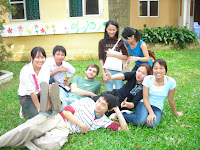
Class K2C.

Melia and Thuan, a girl from the orphanage.
Last week, our team took a train south to the wonderful city of Vinh in order to observe the lives of teachers from our organization who are participating in the University Teaching Program (UTP). For those of you who are neither familiar with the nearly recent history of the SRV or with the upbeat musical stylings of Billy Joel, Vinh is the largest city in the Nghe An province, the birthplace of Ho Chi Minh. It was a great trip and in accordance with ELI policies, I kept close tabs on Anne and Sandy, the two teachers down there. For the first night, it was honestly a little strange watching them while they soundly slept in bed, but by the second and third night, it seemed pretty natural.
Anyways, for one brief morning, we were able to venture out to Cua Lo, a beach roughly 20 kilometers (okay and just because I’m using the metric system doesn’t mean I’m a terrorist) from Vinh proper. I was able to ride back from this aquatic frolic (can I say that?) with Sandy. She drove me on her motorbike. I was like Tim Allen, Martin Lawrence, William H. Macy, and John Travolta all rolled into one, and she was like their friend. However, during this Eric Estrada-esque adventure, the back tire of the bike sprung two leaks on two different occasions, both of which completely deflated the intertube. With no allen-crescent on hand, I thought we were sunk in a sea of gravelly pavement, but I soon found that in this country, most roads are stocked quite comfortably with workers who are ready to fix your hog at a moment’s notice. The first flat was serviced by a man who ran some type of concession bar at a hospital parking lot and the second by a younger guy who staffed a sugarcane juice stand. In the end, Sandy decided to simply buy a new intertube from the second vender, rather than attempt a second plugging.
As we pulled away from the makeshift service stand, Sandy, in light of the recently suffered circumstances, expressed her frustration with some problems her bike had brought her over the last year and then concluded with compounding cadence that, “There is no such thing as a tune up in Vietnam.”
I thought about this quote for a moment and decided that it was quite an accurate commentary in terms of explaining some things I had observed over the past few months. In this country, it seems that things are in one of two conditions, either they are working or broken, and as a long as whatever you have falls into the former category, then all is well. For example, often when I cycle around the city, I notice bicycles with rusty chains and frames that look as if they won’t make it another block, bikes that I would be weary of even running the smallest errand with. However, as long as they are running and continue to have this capability, then there are no problems. The bike will break down when it breaks down and that is that. In the meantime, use it as it should be used.
This mentality seems to apply to many occurrences I’ve seen here and fits quite well into the laid back and “take it as it comes” philosophy that the culture here functions within. I’d like to write more about that sometime soon as well, because to this high strung American, although sometimes frustrating, it has been a nice breath of fresh air.
…………………….
A few weekends ago, Melia and I were able to go with some of our students at the institute to an orphanage just outside of Hanoi. It was really great seeing them in this setting because it really brought out the best in them. They were giving themselves to others in a way that I would never have seen in the classroom or chatting over tea. Here are some pictures of that refreshing day….

Some of My first year students and some children from the orphanage.

Class K2C.

Melia and Thuan, a girl from the orphanage.
Monday, October 22, 2007
Here's to Mr. Iococa and His Failed Experiment the DeLorean
You never know when or in what form you may get a glimpse of American culture. Yesterday, in one of my speaking classes, the students were working in groups, discussing the possible changes and advances that may take place in the world by the year 2045. (The date the textbook set was 2025, but it’s about 20 years old. Let’s just say that the cover of this text has the silhouette of a man with one of the most unbridled and majestic moustaches you will ever see the outline of and that the picture that accompanies this activity was chocked full of flying cars.) Along with articulating these speculations, they were also given the task of making the following judgment: is this a change for the better, for the worse, or neither and why?
One group suggested that time travel would, by this time, be a reality. When asked if this development would be a positive influence on society, one student said no. His reason was that this would allow people to go back in time and gamble unfairly on past sporting events. I asked him if he got this concept from a certain move sequel and he said yes. I have never been prouder.
When all is said and done, I have to agree with him. Sorry Biff, but due to people like you, the Flux Capacitor is just a little too risky. Take it from me, because thanks to about a dozen time zones, I’m actually writing this from the future.
One group suggested that time travel would, by this time, be a reality. When asked if this development would be a positive influence on society, one student said no. His reason was that this would allow people to go back in time and gamble unfairly on past sporting events. I asked him if he got this concept from a certain move sequel and he said yes. I have never been prouder.
When all is said and done, I have to agree with him. Sorry Biff, but due to people like you, the Flux Capacitor is just a little too risky. Take it from me, because thanks to about a dozen time zones, I’m actually writing this from the future.
Saturday, October 20, 2007
Culture Club part 1 (but not the Boy George kind…for the most part)
When making that sometimes painful transition from fanny pack toting tourist to actual resident, there are a few things you can do to cope with the cultural stress. One option is to remember that you are not alone in this process and that others all around the globe are awkwardly fumbling into strange new lifestyles. For example, Michael Jackson made the leap from the magical world that is the Never Land Ranch to the Middle Eastern country of Bahrain, and judging by his recent lack of publicity, I have to imagine that things are going pretty well for the King of Pop. Sure you can make excuses as to the cause of his successful adaptation. You can speculate that Bahrain is a country lined with zoos and glove shops from coast to coast and that architects there never really warmed up to the prospect of a second story balcony, but in the end, you have to give Michael the nod and face the music (especially the song Billy Jean because the video had light-up sidewalks).
The other option is to take note of those things which seem a bit frustrating when set against your own arbitrary biases that America has endowed you with, intentionally choose to look past these things, and ultimately chalk them up to that neutral entity known as culture. Plus this isn’t really a subject you can tackle egocentrically because, as Newton taught us, for every action, there is an equal and opposite reaction. If I’m frustrated, chances are, the person across the table is experiencing that same negative affect and thankfully, the Vietnamese are an incredibly gracious people, always willing to give me some operational slack, a mentality that deserves emulation. Besides in the end, not to underestimate that force that culture brings to any situation, people are people and we’re all doing the best we can the best we know how.
However, sometimes I fall short of this standard and take advantage of what I like to call the Zach Morris Effect. Go back with me, if you will, to a high time of ripped jeans, neon colors, and hair parted down the middle, the era that launched the just post-pubescent phenomenon known as Saved by the Bell. The lead character was a charismatic heartthrob named Zach Morris who had the ability, with a snap of his finger, to pause time at any moment as a means of narrating his current dilemma and aiding those viewers who had perhaps missed certain key points amidst the intricate plot twists. In his case, all of the characters were frozen in times, and often, just to stick it to his jocky counterpart, he would undue a button or two on Slater’s silk shirt. Yes, Zach could be absolutely vicious.
In Vietnam this finger snap manifests itself in the following way. My students here in Hanoi have quite an impressive English proficiency and many Hanoians know at least a little English and then again, many residents have little to no working knowledge of this ridiculously confusing language. When communicating with these two latter groups there is a mutual ability for each side to speak freely and fastly in their own native language without any fear of their international counterparts comprehending what was spoken (I mean I’m learning Vietnamese, but it’s a tough process, and at this point, unless we’re dealing with numbers or salutational inquiries, people really have to slow down for me to get even an inkling of meaning). As such, I’m able to offer narration on any situation as if the person I’m commenting on isn’t even there, which can be a really dangerous privilege because often these comments are the sarcastic products of cultural frustration.
For example, last night five of us went out for dinner and while we we’re ordering, four different employees were huddling around our table in an uncomfortably close sort of way. One man kept pointing to the menu and speaking to Melia (our American Korean teammate who often gets pegged by the nationals as Vietnamese) and when somebody asked what I thought he was saying, I responded with, “Well judging by his outfit, I can only imagine that he’s describing 19 different ways to say denim in Vietnamese.” It was a spiteful comment and not what an ambassador of any sort should be saying, but it’s a coping mechanism I often fall into. I myself though take no personal responsibility for such episodes and blame it all on Mark-Paul Gosselaar. Okay not really, but seriously, it’s an area I need help with.
.........On another note, here's a link to view some pictures of the team. They were taken by one of our two team leaders so they're mainly just pics of the team hanging out and not us with our students (the latter being something I need to put more of on here because that is really my lifeblood here).
http://www.facebook.com/album.php?aid=8978&l=cd31e&id=612313582
The other option is to take note of those things which seem a bit frustrating when set against your own arbitrary biases that America has endowed you with, intentionally choose to look past these things, and ultimately chalk them up to that neutral entity known as culture. Plus this isn’t really a subject you can tackle egocentrically because, as Newton taught us, for every action, there is an equal and opposite reaction. If I’m frustrated, chances are, the person across the table is experiencing that same negative affect and thankfully, the Vietnamese are an incredibly gracious people, always willing to give me some operational slack, a mentality that deserves emulation. Besides in the end, not to underestimate that force that culture brings to any situation, people are people and we’re all doing the best we can the best we know how.
However, sometimes I fall short of this standard and take advantage of what I like to call the Zach Morris Effect. Go back with me, if you will, to a high time of ripped jeans, neon colors, and hair parted down the middle, the era that launched the just post-pubescent phenomenon known as Saved by the Bell. The lead character was a charismatic heartthrob named Zach Morris who had the ability, with a snap of his finger, to pause time at any moment as a means of narrating his current dilemma and aiding those viewers who had perhaps missed certain key points amidst the intricate plot twists. In his case, all of the characters were frozen in times, and often, just to stick it to his jocky counterpart, he would undue a button or two on Slater’s silk shirt. Yes, Zach could be absolutely vicious.
In Vietnam this finger snap manifests itself in the following way. My students here in Hanoi have quite an impressive English proficiency and many Hanoians know at least a little English and then again, many residents have little to no working knowledge of this ridiculously confusing language. When communicating with these two latter groups there is a mutual ability for each side to speak freely and fastly in their own native language without any fear of their international counterparts comprehending what was spoken (I mean I’m learning Vietnamese, but it’s a tough process, and at this point, unless we’re dealing with numbers or salutational inquiries, people really have to slow down for me to get even an inkling of meaning). As such, I’m able to offer narration on any situation as if the person I’m commenting on isn’t even there, which can be a really dangerous privilege because often these comments are the sarcastic products of cultural frustration.
For example, last night five of us went out for dinner and while we we’re ordering, four different employees were huddling around our table in an uncomfortably close sort of way. One man kept pointing to the menu and speaking to Melia (our American Korean teammate who often gets pegged by the nationals as Vietnamese) and when somebody asked what I thought he was saying, I responded with, “Well judging by his outfit, I can only imagine that he’s describing 19 different ways to say denim in Vietnamese.” It was a spiteful comment and not what an ambassador of any sort should be saying, but it’s a coping mechanism I often fall into. I myself though take no personal responsibility for such episodes and blame it all on Mark-Paul Gosselaar. Okay not really, but seriously, it’s an area I need help with.
.........On another note, here's a link to view some pictures of the team. They were taken by one of our two team leaders so they're mainly just pics of the team hanging out and not us with our students (the latter being something I need to put more of on here because that is really my lifeblood here).
http://www.facebook.com/album.php?aid=8978&l=cd31e&id=612313582
Tuesday, October 9, 2007
Eleanor Rigby vs Penny Lane
Here are some pictures from the last two months: two of the average Hanoi landscape, two of my students, and one of our team in China at the Great Wall. Let me know if there are specific kinds of things you want to see pictures of on here. Gregg, I know you're looking for shots of the architecture and I will soon deliver.

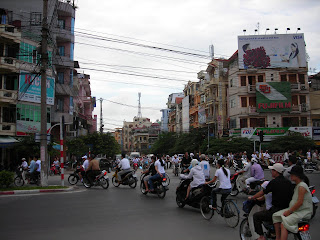
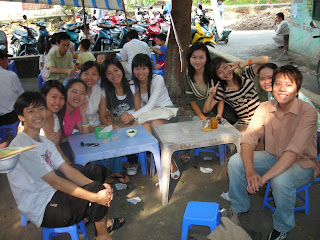


A lot has happened since the last post.
When we first arrived in Hanoi, the institute put us up in a hotel. However, about a week and a half ago we moved into the school's guesthouse. It's right next to do the school, and, in turn, demands only a short walk to class that affords certain privileges a ten minute bicycle ride cannot. Case in point, I’m now able to bring a hot cup of coffee to my 7am classes on Mondays and Tuesdays, a cargo I was never brave enough to carry on my sweet three speed ride. True, I do wear a helmet on my bike, but that’s only so much protection. For example, that kind of bravado could have scalded my teaching arm. Such an injury might have taken off some arm hair, which would probably be a good thing in a country where body hair is about as common as a reference to Andrew Dice Clay, but it’s still not worth it. Besides, if it didn’t make Robin Williams self-conscious to be here, then what do I have to worry about.
In this guesthouse, I share a room with Scott, a good friend whom I met in Nam during my summer teaching stint in ’06. It’s modest and adequate and comfortable. In many ways it’s like living in the dorms again, which I really like. We have an adjoining bathroom that, when we first moved in, had a pretty bad leak (actually leak is too weak of a word, it was really more of a spurt shooting out of the wall). On top of that, the tank on the toilet was broke and couldn’t fill up, rendering that cathartic act of flushing impossible. However, Scott, with the amazing ingenuity of that basketball coach who finally put Air Bud in the game, took the two problems and cancelled them out. He used a bucket to catch the spurt and then emptied the contents into the tank. I was honestly impressed. He found that creative third way.
This new location is also great for relationships. You can never underestimate the power of proximity. I see my students all the time now as I’m out and about living in Hanoi. Last Saturday I simply walked outside my place and met a group of students for lunch. We had a really good time. Most of them are from provinces outside of Hanoi so they actually live in the next building over. It’s referred to as the student hostel. The main course was a soup called Lau, a meal with quite the selection of ingredients. I asked them specifically about one strange looking piece of meat that they had deposited in my bowl. It was beige colored, cut into a wide but then strips, and covered with small spiky bumps. Stupidly, I asked them what it was before I ate it. They said it came from the cow’s stomach. Without asking any further questions, I wrapped it in veggies, counted to three, took a few cautionary bites, and swallowed hard. A few days later I found out that it’s called tripe and it’s the lining of a cow’s udders. That’s right, they’re not just for milk anymore.
That's about all for now, but I'll write more soon. Also, those on my newsletter list....I'll be sending in my first edition to ELI headquarters this week so hopefully it will arrive at your door about two weeks after that. I apologize for not sending one out sooner. There are some things in it that I can't wait to share with you.
Take care and keep in touch.


A lot has happened since the last post.
When we first arrived in Hanoi, the institute put us up in a hotel. However, about a week and a half ago we moved into the school's guesthouse. It's right next to do the school, and, in turn, demands only a short walk to class that affords certain privileges a ten minute bicycle ride cannot. Case in point, I’m now able to bring a hot cup of coffee to my 7am classes on Mondays and Tuesdays, a cargo I was never brave enough to carry on my sweet three speed ride. True, I do wear a helmet on my bike, but that’s only so much protection. For example, that kind of bravado could have scalded my teaching arm. Such an injury might have taken off some arm hair, which would probably be a good thing in a country where body hair is about as common as a reference to Andrew Dice Clay, but it’s still not worth it. Besides, if it didn’t make Robin Williams self-conscious to be here, then what do I have to worry about.
In this guesthouse, I share a room with Scott, a good friend whom I met in Nam during my summer teaching stint in ’06. It’s modest and adequate and comfortable. In many ways it’s like living in the dorms again, which I really like. We have an adjoining bathroom that, when we first moved in, had a pretty bad leak (actually leak is too weak of a word, it was really more of a spurt shooting out of the wall). On top of that, the tank on the toilet was broke and couldn’t fill up, rendering that cathartic act of flushing impossible. However, Scott, with the amazing ingenuity of that basketball coach who finally put Air Bud in the game, took the two problems and cancelled them out. He used a bucket to catch the spurt and then emptied the contents into the tank. I was honestly impressed. He found that creative third way.
This new location is also great for relationships. You can never underestimate the power of proximity. I see my students all the time now as I’m out and about living in Hanoi. Last Saturday I simply walked outside my place and met a group of students for lunch. We had a really good time. Most of them are from provinces outside of Hanoi so they actually live in the next building over. It’s referred to as the student hostel. The main course was a soup called Lau, a meal with quite the selection of ingredients. I asked them specifically about one strange looking piece of meat that they had deposited in my bowl. It was beige colored, cut into a wide but then strips, and covered with small spiky bumps. Stupidly, I asked them what it was before I ate it. They said it came from the cow’s stomach. Without asking any further questions, I wrapped it in veggies, counted to three, took a few cautionary bites, and swallowed hard. A few days later I found out that it’s called tripe and it’s the lining of a cow’s udders. That’s right, they’re not just for milk anymore.
That's about all for now, but I'll write more soon. Also, those on my newsletter list....I'll be sending in my first edition to ELI headquarters this week so hopefully it will arrive at your door about two weeks after that. I apologize for not sending one out sooner. There are some things in it that I can't wait to share with you.
Take care and keep in touch.
Sunday, September 30, 2007
Some real conversation for your....
I’ve been thinking about Jack Kerouac’s book On the Road lately. In the novel, Sal Paradise goes back and forth, from one ocean to another across the American landscape, many times in hopes of finding exactly what his last name so blatantly suggests. In the end, he finds that there is no perfect place and that anywhere you are, you have to deal with the same personal, interpersonal, and spiritual stuff. Sal realizes this, albeit with some resignation, but his friend, Dean Moriarty, never does and foolishly keeps looking for a place that doesn’t exist. As such, Dean lives in a state of unquenchable, but very fleeting excitement, and leaves damaged roots everywhere he goes.
I think that’s kind of what that book is about, but it’s been about a year since I read it, and maybe I’ve made it into something it isn’t. Regardless, it’s been a comforting thought. I mean in the end, we should never feel completely at home anywhere we go. We’re all, every single one of us, foreigners. There is something bigger and something better, and it’s those longings in us that can’t be fulfilled that let us know that this is true. So in the present, let’s not make this an excuse for complacency, but instead go to where the need is and meet it the best we can. There is no paradise here on this globe that you can escape to, but there are places everywhere that you can help make at least a little better.
I listened to a talk by Rob Bell yesterday called “Heaven and Wine” on Melia’s ipod. It was amazing and I would encourage everyone to check it out. Our focus has to be here. It’s Gnosticism to only think of the beyond without working to change the present. The now (the physical) can be made good and it’s every single person’s responsibility to aid that process.
Such things might be contradictory and maybe that’s because I’m just typing as fast as my thoughts are coming, but in the end, the relation of the finite to the infinite is a bit paradoxical. Kierkegaard (the king of the paradox), in Fear and Trembling, says the standard is the knight of faith, and not the knight of infinite resignation. “A purely human courage is required to renounce the whole world of the temporal to gain the eternal; but this I do gain, and to all eternity I cannot renounce it – that being a self contradiction. But a paradox enters in, and a humble courage is required to grasp the whole of the temporal by virtue of the absurd, and this is the courage of faith.”
With all of this in mind, I’m grateful to be here in Vietnam and I’m also grateful that all of you are exactly where you are. Derek Webb, in an interview with Donald Miller, (which might just be my favorite sound bite ever) talks about brining people a taste of what is to come. His example: there are 300 million without drinking water in Africa. By helping to build wells in these struggling communities and empowering the people to continue the work, we are giving them a taste of paradise. By helping to meet their thirst, we are giving them a glimpse of a place where there is no thirst. With this in mind, let's all act both locally and globally.
I hope all that made since. It’s been a tough, but good, week as I continue to adjust to my role here and all these things have been heavy on my mind. Maybe some of the things I said were wrong according to that most abstract, but still important, of sciences that oftentimes burns more bridges than it builds, but, once again, it’s just what I’ve been thinking about lately.
Be brave, be courageous, and be bold. As C.S. Lewis says in A Grief Observed, “Only a real risk tests the reality of a believe.” And of course, thank you so much to all of you who have helped me to get here and have kept me in your thoughts. Without you, this risk wouldn’t be possible.
Sorry this post wasn’t funny, but as the T.V. theme song used to say, “Different Strokes rule the world.” That show, believe it or not, was Different Strokes. So thank you for your wise words Gary Coleman.
…On another note, this morning I was at a gathering with a woman from Burma. She broke into tears while discussing the current situation and the lack of safety for the people there. It made that issue so much more real. Please, if you could, keep this in your thoughts as well.
…I’ll post with some pics very soon too, in hopes to describe a little more concretely just what life over here is like.
Take care.
I think that’s kind of what that book is about, but it’s been about a year since I read it, and maybe I’ve made it into something it isn’t. Regardless, it’s been a comforting thought. I mean in the end, we should never feel completely at home anywhere we go. We’re all, every single one of us, foreigners. There is something bigger and something better, and it’s those longings in us that can’t be fulfilled that let us know that this is true. So in the present, let’s not make this an excuse for complacency, but instead go to where the need is and meet it the best we can. There is no paradise here on this globe that you can escape to, but there are places everywhere that you can help make at least a little better.
I listened to a talk by Rob Bell yesterday called “Heaven and Wine” on Melia’s ipod. It was amazing and I would encourage everyone to check it out. Our focus has to be here. It’s Gnosticism to only think of the beyond without working to change the present. The now (the physical) can be made good and it’s every single person’s responsibility to aid that process.
Such things might be contradictory and maybe that’s because I’m just typing as fast as my thoughts are coming, but in the end, the relation of the finite to the infinite is a bit paradoxical. Kierkegaard (the king of the paradox), in Fear and Trembling, says the standard is the knight of faith, and not the knight of infinite resignation. “A purely human courage is required to renounce the whole world of the temporal to gain the eternal; but this I do gain, and to all eternity I cannot renounce it – that being a self contradiction. But a paradox enters in, and a humble courage is required to grasp the whole of the temporal by virtue of the absurd, and this is the courage of faith.”
With all of this in mind, I’m grateful to be here in Vietnam and I’m also grateful that all of you are exactly where you are. Derek Webb, in an interview with Donald Miller, (which might just be my favorite sound bite ever) talks about brining people a taste of what is to come. His example: there are 300 million without drinking water in Africa. By helping to build wells in these struggling communities and empowering the people to continue the work, we are giving them a taste of paradise. By helping to meet their thirst, we are giving them a glimpse of a place where there is no thirst. With this in mind, let's all act both locally and globally.
I hope all that made since. It’s been a tough, but good, week as I continue to adjust to my role here and all these things have been heavy on my mind. Maybe some of the things I said were wrong according to that most abstract, but still important, of sciences that oftentimes burns more bridges than it builds, but, once again, it’s just what I’ve been thinking about lately.
Be brave, be courageous, and be bold. As C.S. Lewis says in A Grief Observed, “Only a real risk tests the reality of a believe.” And of course, thank you so much to all of you who have helped me to get here and have kept me in your thoughts. Without you, this risk wouldn’t be possible.
Sorry this post wasn’t funny, but as the T.V. theme song used to say, “Different Strokes rule the world.” That show, believe it or not, was Different Strokes. So thank you for your wise words Gary Coleman.
…On another note, this morning I was at a gathering with a woman from Burma. She broke into tears while discussing the current situation and the lack of safety for the people there. It made that issue so much more real. Please, if you could, keep this in your thoughts as well.
…I’ll post with some pics very soon too, in hopes to describe a little more concretely just what life over here is like.
Take care.
Friday, September 21, 2007
You just can't take the effect and make it the cause.
Sorry for the hiatus. I'm just now getting over a pretty bad cold that had about a two week duration. They say that when you move to a new environment, like Vietnam, it's pretty common to get sick like this because all of the pathogens are, at least to this denim clad American immune system, pretty novel. I tried to hold out, but eventually I caved and bought some antibiotics. The pharmacy was a glass counter inside of a small street vender shop and David, my team leader, walked me through the process. The majority of the transaction, on my end, was me wincing and grabbing my throat while the young woman across the counter nodded her head. In the end, I paid a wopping 69,000 dong, which is pretty cheap considering Hanoi is pretty expenisive when compared ot most Southeast Asian cities.
Needless to say, a sore throat isn't exactly the perfect complement to a new teaching regiment. However, classes actually went pretty well. All in all, I;m teaching five 2.5 hour classes each week: 1 sophomore speaking class, 2 freshmen speaking classes, and 2 international relations classes for juniors. I enjoy them all, but I enjoy the i.r. classes the most as it's in these classes that we tend to delve into the most interesting discussions, because honestly, we tackle some pretty big issues. For example, this week's lesson was over the Aids crisis and next week's covers the Israeli-Palestinian issue.
I'm also starting to develop relationships with some of the students. I met with a student for tea this morning, then Scott and I had lunch with two Combodian students, and tomorrow I'm touring Hanoi with one of my junior classes. By far, it's the relationships that make my time here the most enjoyable.
I shared this with Sue already, but on another note, and at the risk of sounding corny, lately I've discovered a newfound appreciation for Ira Glass and This American Life. One of the programs I listened to lately was about a man who had invented a special kind of tweezer from which he had made millions. Just recently though he decided that he was going to bring peace to Iraq, so he, all by himself, departed for the middle east, left his tweezer know how back in the states, and took on the sensitive role of a diplomat. You've got to love that mentality.
Needless to say, a sore throat isn't exactly the perfect complement to a new teaching regiment. However, classes actually went pretty well. All in all, I;m teaching five 2.5 hour classes each week: 1 sophomore speaking class, 2 freshmen speaking classes, and 2 international relations classes for juniors. I enjoy them all, but I enjoy the i.r. classes the most as it's in these classes that we tend to delve into the most interesting discussions, because honestly, we tackle some pretty big issues. For example, this week's lesson was over the Aids crisis and next week's covers the Israeli-Palestinian issue.
I'm also starting to develop relationships with some of the students. I met with a student for tea this morning, then Scott and I had lunch with two Combodian students, and tomorrow I'm touring Hanoi with one of my junior classes. By far, it's the relationships that make my time here the most enjoyable.
I shared this with Sue already, but on another note, and at the risk of sounding corny, lately I've discovered a newfound appreciation for Ira Glass and This American Life. One of the programs I listened to lately was about a man who had invented a special kind of tweezer from which he had made millions. Just recently though he decided that he was going to bring peace to Iraq, so he, all by himself, departed for the middle east, left his tweezer know how back in the states, and took on the sensitive role of a diplomat. You've got to love that mentality.
Subscribe to:
Posts (Atom)